
Formulating a Research Question for a Literature Review
To formulate a research question for a literature review, start with a broad topic, identify the relationship or issue the review needs to analyse, add only boundaries that materially change the inquiry, and phrase the result as an open, answerable question. A strong question is clear, focused, answerable from relevant published literature, and analytical enough to support synthesis; then test whether its core concepts can guide the later literature search.
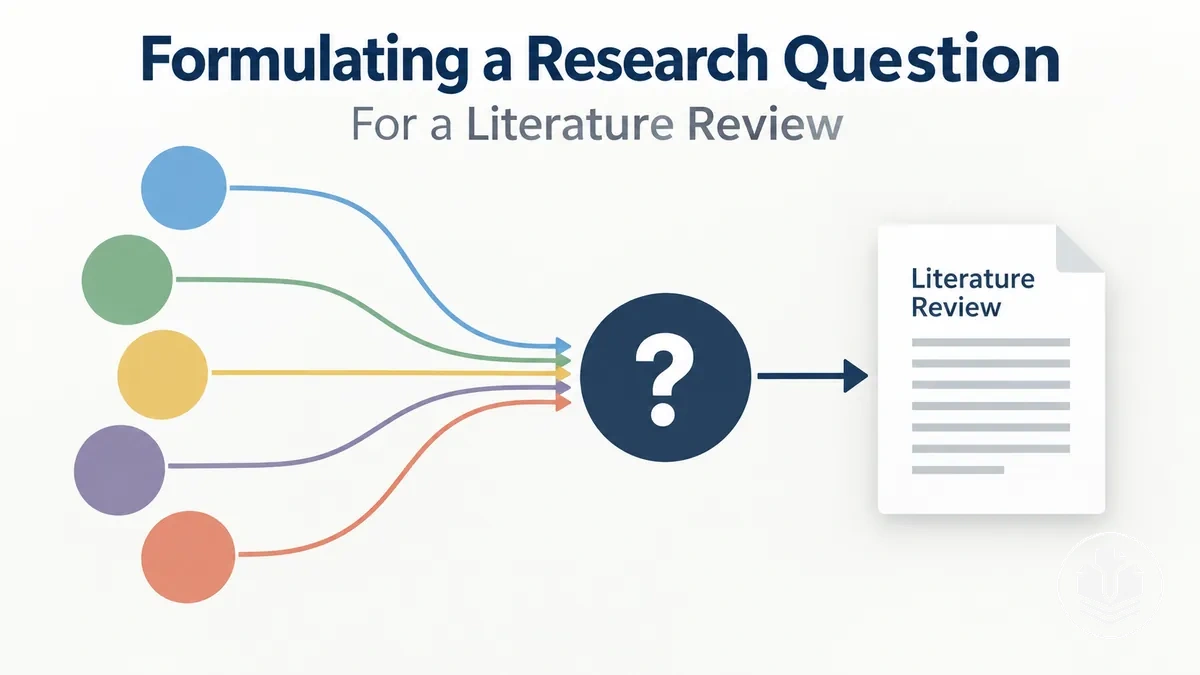
At a glance
Build the question in five decisions
Move from a broad subject to a reviewable inquiry, then use the quality gate to decide what still needs refinement.
- TopicName the broad subject area without forcing the final wording yet.
- Analytical focusIdentify the relationship, difference, explanation, outcome or issue the review needs to examine.
- Meaningful boundariesAdd population, setting, timeframe, geography or a theoretical lens only when it changes the inquiry or relevant literature.
- Question wordingPhrase an answerable inquiry that requires analysis rather than merely naming the topic or inviting only a yes-or-no response.
- Feasibility checkConfirm that relevant literature appears available and that the core concepts are clear enough to guide later search planning.
Quality gate
- Clear
- Key concepts and relationships are not materially ambiguous.
- Focused
- The scope is bounded enough for one coherent review.
- Answerable
- Relevant published literature can reasonably address the inquiry.
- Analytical
- The answer requires explanation, comparison, interpretation or synthesis.
Decision rule: keep a boundary only when it improves the inquiry or changes which literature is relevant. There is no universal number of boundaries that makes a research question valid.
The exact breadth depends on the field, review purpose and available literature. The practical standard is a question that gives the review a coherent focus while retaining enough relevant evidence for meaningful analysis and synthesis.
Table of Contents
What a Literature Review Research Question Needs to Do
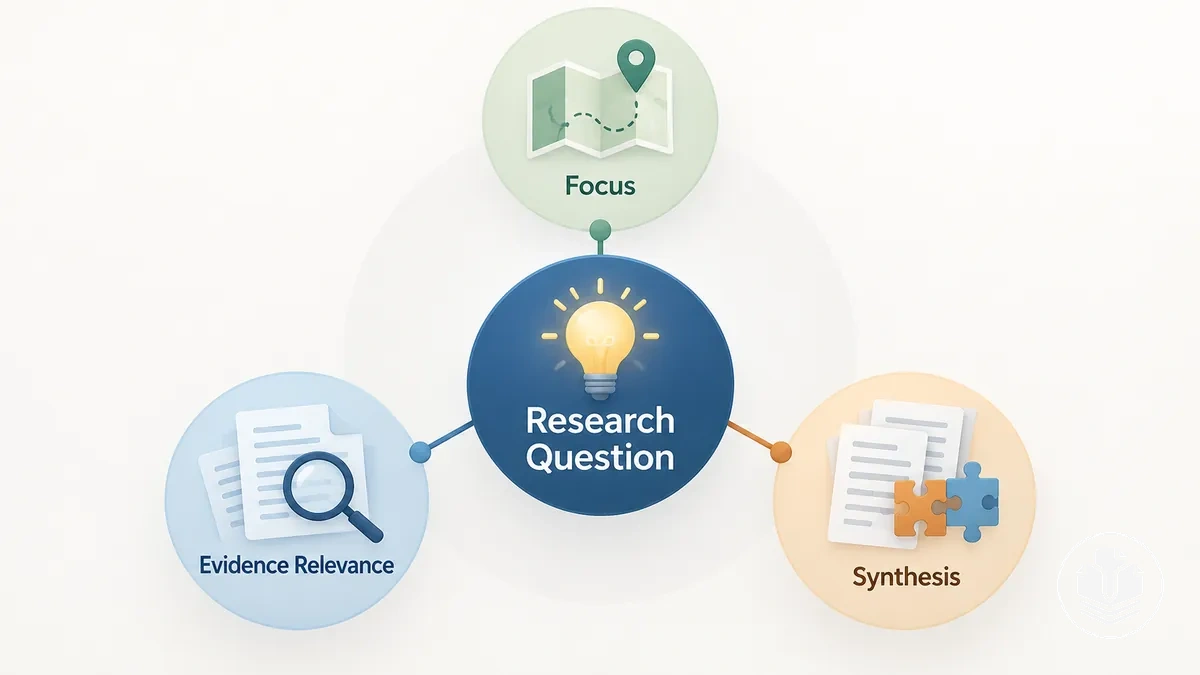
A literature review research question must give the review a clear focus, establish evidence relevance, and provide an analytical purpose for the inquiry.
Its boundaries direct attention towards literature that can contribute to answering the question rather than material connected only to the broader topic.
The question therefore frames what the review needs to examine and interpret.
These functions support synthesis by giving the relevant literature a shared inquiry around which findings, explanations, relationships, or differences can be interpreted.
The research question defines the intellectual purpose and boundaries of the review, while the precise breadth and form of those boundaries can differ with the review context; the mechanics used later to locate and select literature are separate tasks.
Criteria for a Focused and Answerable Review Question
A usable literature review research question should be clear, focused, answerable from a relevant evidence base, and capable of supporting analytical depth.
These qualities provide an evaluation frame for deciding whether the question is sufficiently defined to guide a feasible review without assuming that every discipline or review context requires the same breadth.
Clarity reduces ambiguity in how the inquiry is interpreted, while a manageable scope establishes meaningful boundaries around what the question asks.
Answerability depends on whether an appropriate evidence base is available to address the inquiry, and analytical depth requires a question that supports explanation, comparison, interpretation, or synthesis rather than only a superficial response.
The appropriate breadth and evidence sufficiency depend on the review context and field, so these criteria evaluate the literature review research question itself rather than the later rules used to select individual sources.
The criteria below evaluate distinct attributes of the question itself and connect each acceptable condition to its implication for review usability and feasibility.
- Clarity: the wording is sufficiently specific to limit ambiguity, allowing the inquiry to be interpreted consistently.
- Focus: the question has a manageable scope with meaningful boundaries, keeping the evidence base sufficiently bounded for feasible synthesis.
- Answerability: an appropriate evidence base is available to address the question, allowing the literature to contribute to a supported answer.
- Analytical depth: the question supports explanation, comparison, interpretation, or another substantive form of analysis, giving the review analytical value beyond description alone.

Make the Question Clear, Specific, and Answerable
A research question is clear when its wording limits ambiguity, specific when its boundaries identify what the inquiry will examine, and answerable when relevant published literature is reasonably available to address it.
These checks evaluate the wording and feasibility of the question itself, not the eventual volume of search results.
- Clarity: use wording that gives key concepts a consistent interpretation; ambiguous terms may cause the question to be understood in different ways.
- Specificity: define meaningful boundaries around the subject, relationship, population, setting, or other relevant context; insufficient boundaries can leave the inquiry too broad to examine coherently.
- Evidence availability: frame a question that can reasonably be addressed using published literature; limited relevant evidence may constrain how completely the question can be answered.
- Manageable breadth: keep the inquiry sufficiently bounded for its context; excessive breadth can produce an evidence base that is difficult to analyse and synthesise as one coherent question.
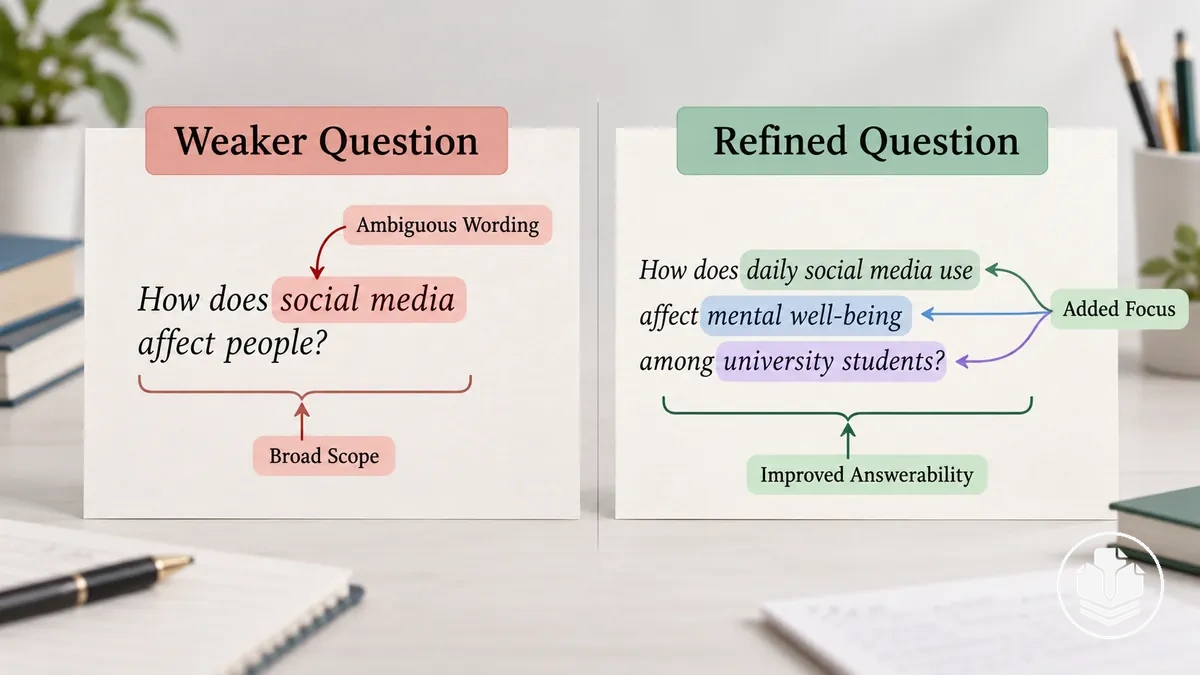
For example, the broad question “How does technology affect students?” leaves both “technology” and the relevant student outcome ambiguous.
A more precise formulation such as “How does social media use relate to academic engagement among university students?” adds a defined technology, outcome, and population, making the intended interpretation clearer while leaving answerability dependent on evidence availability.
The wording changes highlighted here show how resolving ambiguity and adding meaningful focus can improve the question without imposing a fixed breadth threshold.
Use a Question That Requires Analysis Rather Than a Yes-or-No Answer
A yes-or-no research question tends to invite a binary answer, whereas an analytical question asks the review to explain, compare, interpret or synthesise what the literature shows.
Closed wording is not unusable in every research context, but it can constrain a literature review when the purpose is to examine conditions, relationships, differences or explanations.
The same topic can therefore create a different review task depending on how the relationship is verbalised.
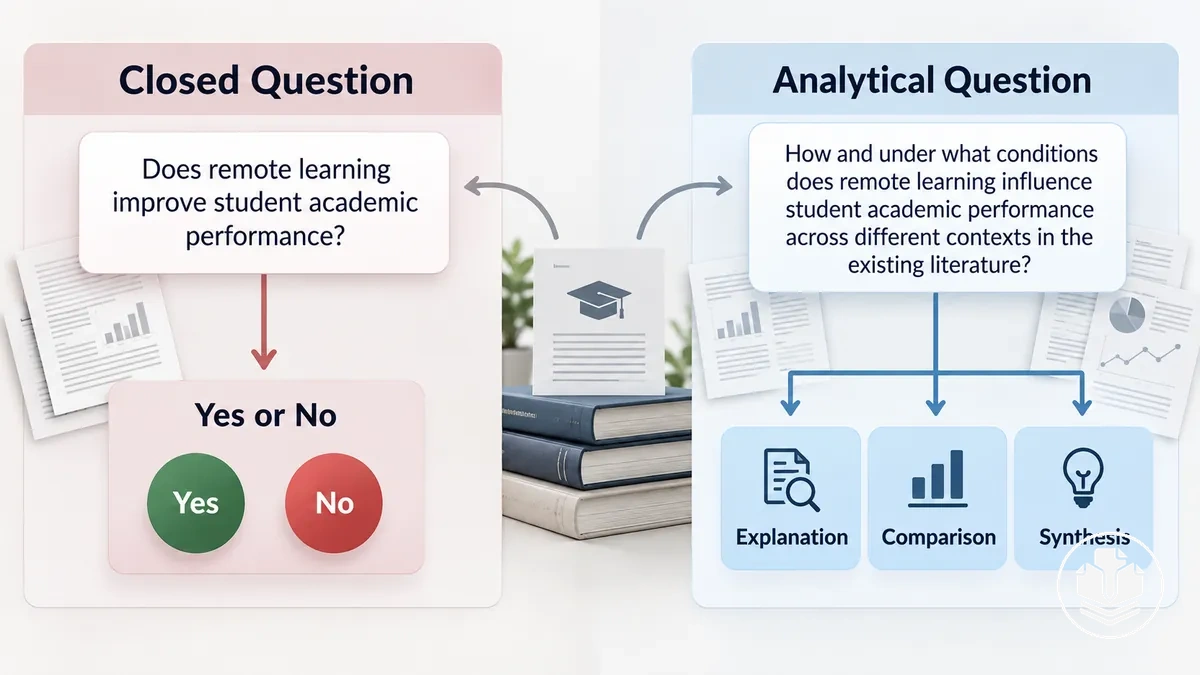
Closed form
“Is social media use related to academic engagement among university students?”
Likely review task: establish whether a relationship is present, which can limit attention to conditions and variation.
Analytical form
“How does social media use relate to academic engagement among university students, and under what conditions does that relationship vary?”
Likely review task: interpret the relationship and compare the conditions under which it varies, creating a stronger basis for synthesis.
Question words such as how, why, what or which can help establish an open inquiry, but the question word alone does not create analytical depth.
The predicate and relationship must still require substantive explanation, comparison, interpretation or synthesis.
How to Turn a Broad Topic into a Research Question
A broad topic becomes a research question by selecting a specific focus, adding only the boundaries that make the inquiry meaningful, and phrasing it as an answerable question.
The five-stage refinement below reduces ambiguity progressively without automatically making the question narrower than the literature review requires.
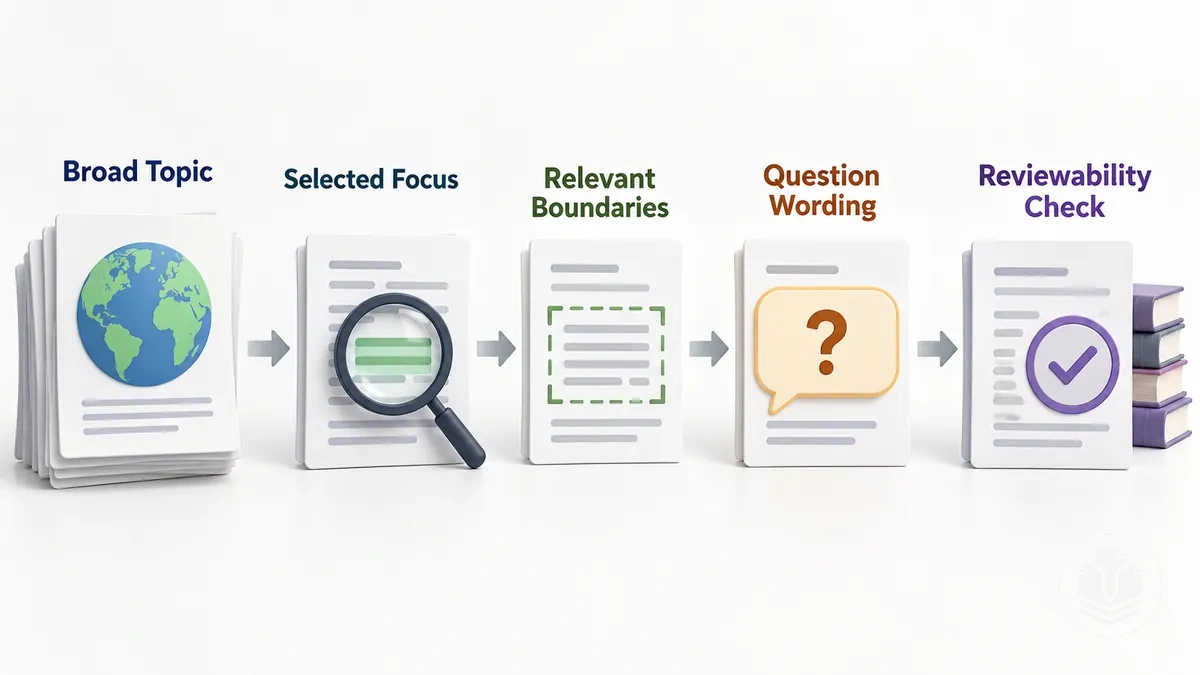
- Identify the broad topic. Start with the subject area you want to investigate and state it without trying to form the final question yet. For example, begin with social media and university students; check that the topic identifies the general area while still leaving room to select a more precise focus.
- Isolate the issue or relationship. Decide what within the broad topic you want the review to understand, such as a relationship, outcome, difference, or explanation. The example can become the relationship between social media use and academic engagement among university students; check that the focus identifies what the literature needs to help explain or analyse.
- Select meaningful boundaries. Add only context that helps define the inquiry, such as a relevant population, setting, or timeframe when it materially changes what the question asks. In the example, retaining university students establishes the population boundary; check that each boundary improves focus rather than narrowing the inquiry without a clear purpose.
- Phrase the research question. Convert the focused and bounded subject into an answerable inquiry that invites analysis and synthesis. The example becomes “How does social media use relate to academic engagement among university students?”; check that the wording asks a specific question rather than merely naming the topic.
- Verify reviewability. Check whether the refined research question is sufficiently specific to guide the review while retaining enough breadth to examine and synthesise relevant literature. If the available literature cannot reasonably address the question, or the question still contains several loosely connected inquiries, refine the focus or boundaries before proceeding.
A reviewable research question balances focus with sufficient breadth for synthesis rather than pursuing maximum narrowness.
The appropriate balance depends on the review context and literature availability, so the final check is whether the question can guide a coherent review without requiring a fixed number or type of boundaries.
Separate the Topic from the Question the Review Will Answer
A topic names the broad subject area of interest, whereas a research question specifies the bounded inquiry the literature review is expected to answer.
The distinction is functional: the topic establishes subject breadth, while the research question turns that subject into a task that can guide evidence relevance and synthesis.
| Attribute | Topic | Research question |
|---|---|---|
| What it names | A broad area of interest. | The particular inquiry the review is expected to answer. |
| Typical breadth | Can remain broad. | Introduces meaningful boundaries around what the review will examine. |
| Role in evidence relevance | Signals general subject relevance. | Guides attention towards literature that can help answer the inquiry. |
For example, “social media and university students” is a topic, while “How does social media use relate to academic engagement among university students?” is a research question focused on a specific relationship.
Narrow the Question with Relevant Boundaries
Research question boundaries should be added only when they materially change the literature relevant to the inquiry or clarify its focus.
Population, context, timeframe, geography, and theoretical lens are optional decision dimensions rather than mandatory fields, so each boundary should correspond to a condition that matters to the question.
- Population or unit: specify a population or unit when the inquiry concerns a particular group or object and that condition changes which literature is relevant; for example, limiting a question about academic engagement to university students can distinguish the intended population from school students.
- Context or setting: specify the context when the setting changes how the issue or relationship is understood, such as examining a phenomenon specifically within higher education rather than across unrelated settings.
- Timeframe: add a timeframe when a defined period is substantively relevant to the inquiry, such as when the question concerns evidence associated with a particular policy period or historical change.
- Geography: specify a geographic boundary when location materially affects the population, context, conditions, or evidence relevance; otherwise, an arbitrary location constraint may only reduce the literature base.
- Theoretical lens: name a theoretical lens when the review is intentionally examining the literature through that framework; adding one without a clear analytical purpose may constrain otherwise relevant evidence.
Useful precision comes from selecting question-level boundaries that change the inquiry, not from stacking every possible constraint into the research question; for example, specifying university students may improve focus, while combining an unnecessarily narrow population, location, timeframe, and theoretical lens may over-restrict the literature base.
More detailed decisions about how far those limits should extend belong to the separate task of how to define the scope, while the research question should remain focused enough to guide evidence relevance and broad enough to support meaningful synthesis.
Examples of Broad Topics Refined into Focused Questions
Each example shows the same transformation: a broad topic is narrowed into a focused area, then expressed as a research question with a meaningful boundary, sufficient answerability, and enough analytical depth for synthesis.
The subject matter changes, but the refinement pattern remains consistent.
| Broad topic | Focused area | Final research question |
|---|---|---|
| Social media and students | Social media use and academic engagement among university students, adding a population boundary that narrows an overly broad topic. | How does social media use relate to academic engagement among university students? |
| Remote work | Remote work arrangements and employee collaboration in knowledge-based organisations, adding a defined relationship and organisational context. | How do remote work arrangements influence collaboration among employees in knowledge-based organisations? |
| Renewable energy adoption | The closed question “Do financial incentives increase household solar adoption?” is reframed to examine conditions and variation rather than only a yes-or-no outcome. | How do financial incentives influence household solar adoption, and under what conditions does their influence vary? |
Across the examples, the shared pattern is a shift from a broad or limited formulation to a focused inquiry with a relevant boundary and an analytical burden that supports interpretation and synthesis.
When to Use a Research Question Framework
A research question framework is useful when the question needs a systematic way to identify its essential concepts and boundaries.
The framework acts as a scaffold for structuring the inquiry, but its usefulness depends on whether its components fit the actual question context.
PICO and PEO illustrate how different frameworks organise different question elements.
PICO structures population, intervention, comparison, and outcome, so it may suit questions that examine an intervention against an alternative or comparison in relation to defined outcomes; PEO structures population, exposure, and outcome, so it may suit questions centred on an exposure, experience, or condition where an intervention-comparison structure is not appropriate.
For example, PICO can sharpen a broad question about an educational intervention into “Among first-year university students, how does peer mentoring compared with no peer mentoring affect academic engagement?” by making the population, intervention, comparison, and outcome explicit.
| Framework | Components | Suitable question context | Likely effect on focus |
|---|---|---|---|
| PICO | Population, Intervention, Comparison, Outcome | Questions in which an intervention or alternative is examined in relation to specified outcomes for a defined population. | Structures the population, intervention, comparison, and outcome so the question's main analytical elements are explicit. |
| PEO | Population, Exposure, Outcome | Questions centred on a population's exposure, experience, or condition and an associated outcome, including qualitative question contexts where this structure fits. | Organises the population, exposure, and outcome without requiring an intervention-versus-comparison structure. |
No framework is universally required. Forcing a question into an unsuitable component set can distort the inquiry rather than clarify it, so framework choice should follow the question structure rather than replace judgement about fit.
Framework choice should therefore remain subordinate to the question's informational need, while decisions that depend on the wider review design are better addressed when you understand review types.
How to Test and Refine the Research Question
Test and refine a draft research question iteratively by identifying the specific weakness, adjusting only the question element causing it, and then performing a recheck against the intended literature-review task.
The sequence should examine clarity, scope, evidence availability, analytical depth, and basic feasibility for later searching without treating any single check as conclusive.
- Test clarity. Check whether the draft question identifies its concepts and relationships without material ambiguity. If key wording permits conflicting interpretations, identify the ambiguous term or relationship, revise that element more precisely, and recheck whether the intended inquiry is now clear.
- Test scope. Check whether the question is sufficiently bounded to support a coherent review. If it combines several loosely connected populations, contexts, outcomes, or relationships, adjust the boundary causing excessive breadth rather than narrowing every element, then recheck the resulting focus.
- Check evidence availability. Use a preliminary feasibility check to determine whether relevant published literature appears capable of addressing the question. If the available literature appears insufficient for a particular boundary or concept, revise that question-level constraint where appropriate and recheck feasibility without assuming that preliminary results prove the question correct.
- Test analytical depth. Check whether answering the question requires explanation, comparison, interpretation, relationship analysis, or synthesis rather than description alone. If the wording produces only a closed or descriptive task, reframe the relevant predicate or relationship and recheck the analytical burden.
- Check search feasibility. Check whether the question's central concepts can be identified clearly enough to support later search planning. If important concepts remain indistinct or the wording combines unrelated inquiries, revise the problematic concept or relationship and recheck the draft question rather than developing the full search strategy at this stage.
For example, if a draft question such as “How does technology affect students?” proves excessively broad during a preliminary feasibility check, refinement can target the ambiguous technology, outcome, and population rather than replacing the entire inquiry; it might become “How does social media use relate to academic engagement among university students?” before being rechecked.
A preliminary feasibility check can inform revision, but it does not establish that the revised question is correct; refinement can continue until the question is stable enough for the review task and ready for later search planning.
Check Whether the Question Can Guide the Literature Search
A workable research question exposes identifiable core concepts and meaningful boundaries that can later translate into search concepts.
The criteria below test question-to-search compatibility and expected evidence relevance rather than the execution of a search strategy.
- Identifiable core concepts: the research question should make the main entities, relationships, or outcomes clear enough to recognise which question elements can later become searchable concepts.
- Meaningful boundaries: population, context, timeframe, geography, or another relevant limit should be explicit when it materially changes which literature is relevant; wording that only expresses the inquiry need not become a search concept.
- Evidence feasibility: the identified concepts and boundaries should correspond to literature that can reasonably address the inquiry, although terminology and evidence availability may vary by topic.
For example, in the question “How does social media use relate to academic engagement among university students?”, social media use, academic engagement, and university students are core concepts that can later inform search planning, while words such as how and relate can remain conceptual rather than being searched literally.
This compatibility check identifies usable question elements without constructing detailed search terms or syntax.
Once the research question exposes usable concepts and boundaries, the next task is to develop the search strategy, where those concepts can be translated into detailed search terms and syntax.
Revise Questions That Are Too Broad, Too Narrow, or Mainly Descriptive
A problematic research question is usually recognisable through its effect on the review task.
A question that is too broad can create an overwhelming scope because too many concepts or contexts remain unconstrained; a question that is too narrow may leave an evidence base too limited for meaningful synthesis; and a mainly descriptive question may support summary without requiring enough analysis, comparison, or interpretation.
These states indicate different troubleshooting needs rather than one common correction.
| Question state | Recognition cue | Likely cause | Check | Corrective direction |
|---|---|---|---|---|
| Too broad | The question covers multiple populations, contexts, concepts, or outcomes and creates an unmanageably wide review task. | Important concepts or boundaries may remain unconstrained. | Identify which concept or context is creating unnecessary breadth and whether a meaningful boundary would clarify the inquiry. | Add the smallest relevant boundary. For example, revise “How does technology affect students?” to “How does social media use relate to academic engagement among university students?”. |
| Too narrow | The question contains several restrictive conditions and the relevant evidence base appears sparse or fragmented. | One or more population, geography, timeframe, or contextual limits may be more restrictive than the inquiry requires. | Check whether each restriction materially changes the question and whether removing one still preserves the intended focus. | Relax the least necessary boundary while keeping the central inquiry intact; for example, remove a locality restriction when geography is not analytically important. |
| Mainly descriptive | The question mainly asks what exists, what happened, or which features are present without creating a substantive analytical burden. | The wording may identify a description task without specifying a relationship, difference, explanation, or condition to examine. | Check whether answering the question requires interpretation, comparison, explanation, or synthesis rather than description alone. | Reframe the relationship or predicate. For example, revise “What social media platforms do university students use?” to “How does social media use relate to academic engagement among university students?”. |
A recognition cue does not prove a single likely cause, because scope and evidence availability vary by field and question context.
The corrective direction should therefore target the smallest question-level element responsible for the weakness: add a meaningful boundary when the question is too broad, relax an unnecessary restriction when it is too narrow, or reframe a description-only question around a relationship or analytical task.
Recheck the revised question to confirm that it now supports a workable evidence base and meaningful synthesis without replacing the underlying topic.