
Literature Review Structure: How the Sections Work Together
Literature review structure usually centres on three functions: introduction, body, and conclusion. The introduction defines the review’s focus, scope, and organising logic; the body groups and synthesises related literature in a coherent sequence; and the conclusion consolidates what that synthesis means. In a thesis or larger paper, these functions may be distributed across different sections, so the structure is functional rather than a fixed three-heading template.

Structure at a glance: function → handoff
Read the structure as a chain of responsibilities. Each part establishes what the next part can legitimately develop, so coherence comes from the handoff between functions rather than from fixed section names.
-
1 · Introduction
- Defines
- Topic or focus, scope, and organising logic.
- Hands off
- A bounded direction for the body: what literature belongs and how the discussion will be organised.
-
2 · Body
- Develops
- Connected subsections grouped by a defensible basis such as theme, period, method, debate, or concept.
- Hands off
- A cumulative synthesis of relationships, patterns, differences, developments, and tensions.
-
3 · Conclusion
- Consolidates
- The body’s cumulative patterns, tensions, implications, and overall position.
- Boundary
- Closes the existing synthesis rather than opening a new evidence strand.
Coherence rule: scope → organising basis → subsection synthesis → connected sequence → consolidated position. In a larger research document, the location of these functions can change without changing their structural role.
Table of Contents
The Three Main Sections of a Literature Review
The three main sections of a literature review are the introduction, body, and conclusion, each with a distinct structural purpose.
The introduction establishes the scope and direction, the body develops the review through discussion and synthesis, and the conclusion consolidates the overall position.
Together, these components connect the review's focus to its analysis and resulting significance.
The diagram shows the introduction, body, and conclusion as connected components, with one broad structural function associated with each part.

In a larger research paper or thesis, these functions may be distributed differently according to the document design.
The following sections examine the introduction, body, and conclusion individually without treating their exact content or placement as identical in every academic context.
Introduction: Establishing the Scope and Direction
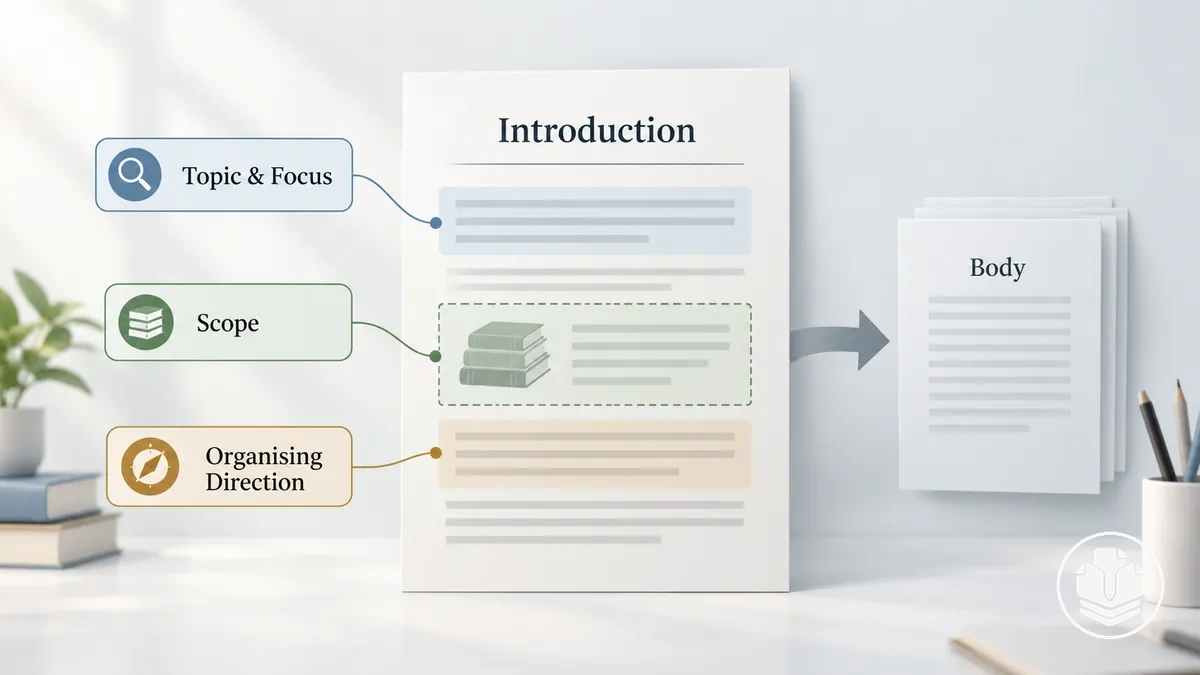
The literature review introduction establishes the topic or focus, defines the scope of literature being considered, and signals the organising logic that gives the body direction.
These choices set the review’s boundaries before substantive synthesis begins. Their exact wording, length, and order can vary with the assignment, discipline, or document convention.
The annotated image identifies these structural functions and shows their handoff to the body rather than presenting a writing template.
Detailed guidance on how to write the introduction and conclusion belongs beyond this structural explanation.
Body: Developing the Review Through Connected Sections
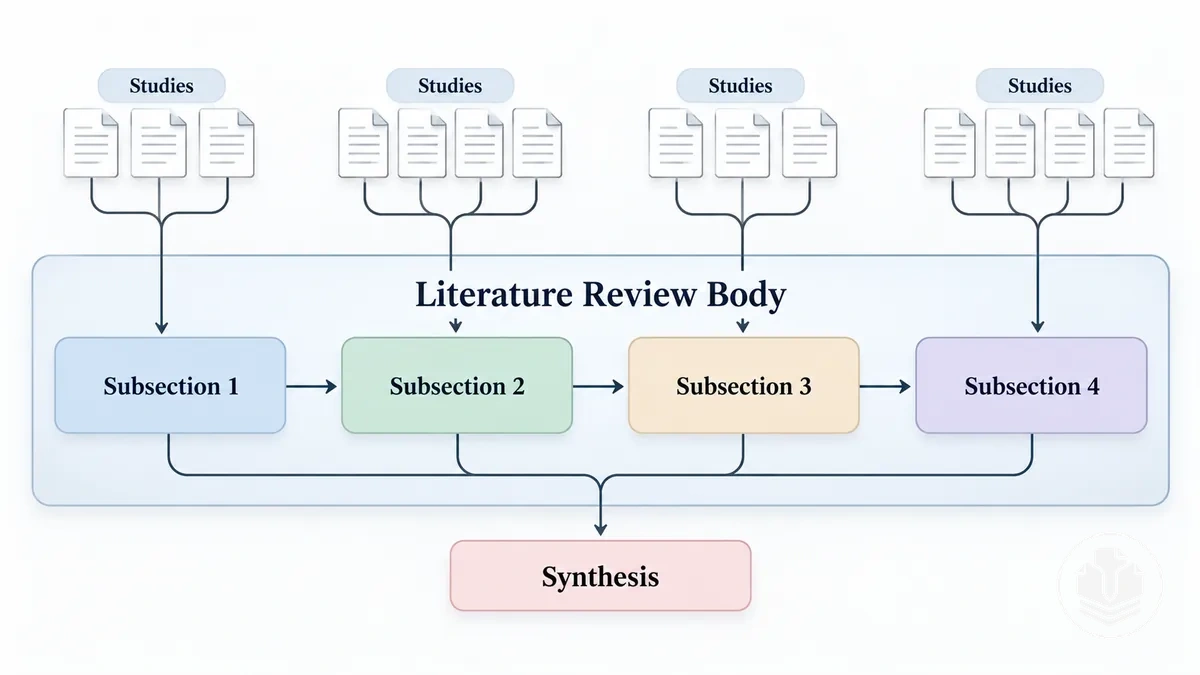
The literature review body carries the main analytical and synthesis burden by grouping related literature into coherent subsections.
Each subsection brings relevant evidence into a shared focus so relationships among studies can be examined rather than presented as isolated summaries.
The grouping basis can vary with the review’s purpose, but each subsection needs a defined function and each connection between subsections needs to maintain progression across the discussion.
The diagram shows this body-level architecture by representing multiple studies feeding into grouped subsections and those subsections connecting within the body.
Detailed guidance on how to write literature review paragraphs belongs beyond this body-level structural explanation.
Conclusion: Consolidating the Review's Overall Position
The literature review conclusion consolidates the synthesis established in the body by bringing its main patterns, tensions, and implications into an overall position.
It relates that consolidated interpretation to the review focus so the significance of the preceding analysis becomes clear.
The image traces this movement from body findings toward a consolidated closing position rather than a new evidence strand.

The conclusion therefore closes the structural loop by interpreting what the existing synthesis means within the review, without opening a new evidence strand.
When a literature review is embedded within a thesis chapter or larger paper, part of this closing function may instead be carried by a later section of that document.
This variation changes where closure occurs, not the distinction between consolidating existing analysis and introducing new literature.
How the Literature Review Body Is Organised into Subsections
Literature review body subsections group related literature around a coherent organising basis so each subsection has a distinct focus and synthesis task.
The suitable organising basis depends on the review focus and may involve a theme, time period, method, debate, concept, or another defensible relationship.
The image shows how one body can contain several coherent groups while keeping those groups connected to the overall focus.
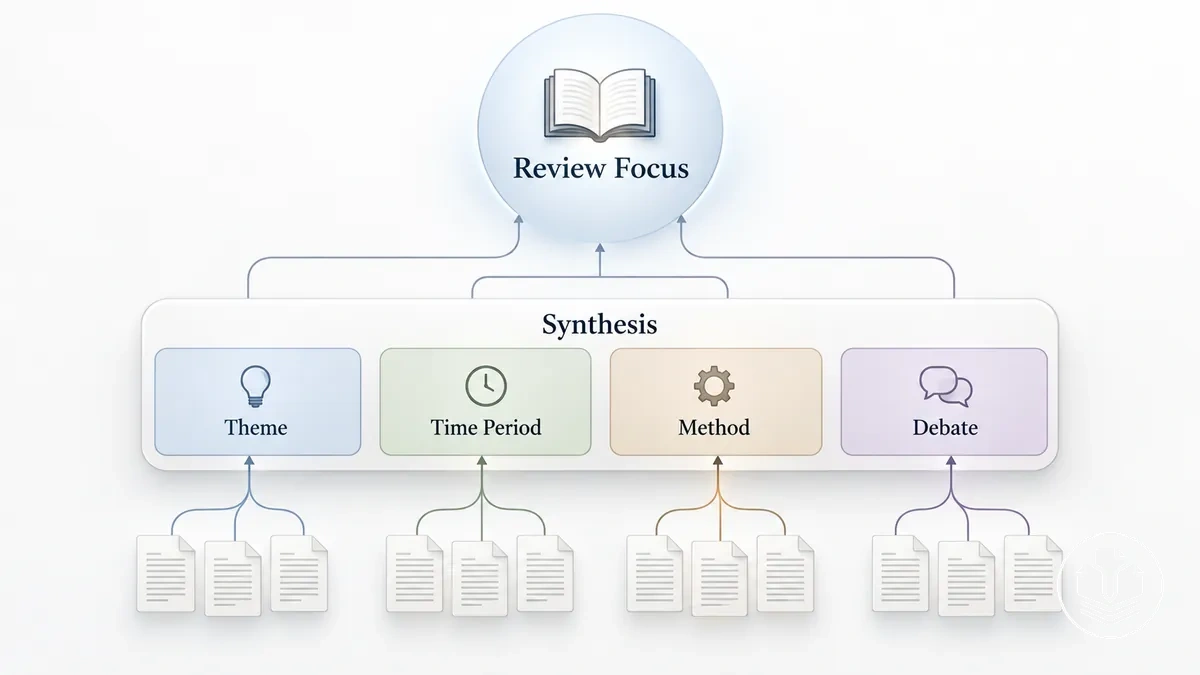
Each subsection contains literature that belongs together under its stated focus, allowing relationships among sources to be synthesised within a defined boundary.
Its function is not merely to hold related studies, but to process their agreements, differences, developments, or other relevant relationships according to that grouping principle.
The resulting synthesis gives the subsection a recoverable contribution to the body rather than leaving it as an arbitrary collection of sources.
Across subsections, those contributions maintain coherence by relating distinct groupings back to the review's overall focus.
Common organising bases
- Theme: groups literature addressing the same recurring issue or subject.
- Time period: groups literature according to periods relevant to changes or developments in the topic.
- Method: groups literature using a shared methodological approach when that distinction serves the review focus.
- Debate: groups literature around competing or related positions on a defined issue.
- Concept: groups literature according to a shared concept or conceptual relationship.
For example, a broad review could contain one subsection focused on an established concept, another on a related debate, and another on later developments.
Each group would synthesise the literature relevant to its own focus while contributing a distinct part of the body's overall reasoning, rather than giving every individual study its own subsection.
Grouping Related Literature Around a Shared Focus
Related literature forms a structurally coherent group when the sources share a meaningful relationship that supports one subsection focus and its synthesis.
-
1 · Shared relationship
Sources may share a question, concept, pattern, debate, period, or method.
-
2 · Subsection focus
Use that relationship to define one local analytical purpose. The grouping should be more meaningful than a superficial identifier such as author name or publication date alone.
-
3 · Synthesis task
Examine where the grouped sources converge, differ, or develop the issue so the subsection contributes to the review’s overall reasoning.
Example: sources from different authors and periods can still belong in one subsection when they address the same debate from contrasting positions; the debate becomes the grouping focus and the synthesis explains the relationship among those positions.
Subsections Follow a Consistent Organising Principle
A subsection organising principle is consistent when readers can recover the grouping rule that explains why material appears within each subsection boundary.
Consistency therefore means an intelligible organising logic rather than mechanical uniformity across every subsection.
A thematic or chronological principle can support coherence when its grouping logic and sequence remain clear, while a hybrid structure can also work when a higher-order logic justifies the variation.
What makes the organising principle recoverable
- Primary basis: Subsection boundaries use a recognisable primary grouping rule, helping readers understand what distinguishes one subsection from another.
- Justified exception: An exception remains consistent when its reason is explicit and still relates to the broader organising principle.
- Interpretable sequence: The subsection sequence follows a relationship readers can recover, which helps maintain coherence across the body.
- Higher-order logic: A hybrid structure supports consistency when one clear structural principle explains why different grouping rules operate in different parts.
Consistency does not require one pure method across every subsection; it requires a grouping logic that remains interpretable when boundaries or approaches change.
Detailed choices about how to organise a literature review thematically or chronologically belong to a separate method comparison.
How Section Order Creates a Coherent Literature Review
Section order creates coherence when the sequence follows a clear organising logic and each section prepares context that the next section can develop.
The important relationship is logical dependency rather than simple position: a section follows another because its function builds on what has already been established.
Within the body, the exact sequence can vary according to the review purpose and chosen organising logic rather than following one universal order.
-
1 · Prior context
A section establishes a focus, pattern, or analytical context.
-
2 · Explicit relationship
The transition makes the dependency recoverable: the next section may extend, contrast, continue, refine, or narrow the preceding synthesis.
-
3 · Next focus
The following subsection develops that relationship rather than switching to an unrelated topic.
-
4 · Cumulative meaning
The sequence becomes interpretable as an argument because each structural unit relates to what precedes and follows it.
Example sequence: established position → competing debate → later evidence that reframes the debate. Reversing those sections can still work, but only when another clear dependency explains the new order.
Key distinction: this is the architecture of the finished literature review, not the literature review process used to search, read, and draft it.
Moving from the Review's Scope into the Main Discussion
The review’s scope and organising logic establish the criteria that justify what the first body subsection should address.
The first subsection should therefore focus on material that follows directly from those boundaries and direction. Which focus comes first can vary with the review’s purpose, but its position should be explainable through the organising logic.
The structural handoff is scope → organising principle → first subsection focus: the introduction constrains the direction, while the body performs the substantive synthesis within those boundaries. This relationship is structural rather than a formula for sentence-level transition wording.
Building Connections Between Successive Body Sections
Successive body sections have a meaningful conceptual connection when the relationship between one subsection’s takeaway and the next subsection’s focus is explicit.
Conceptual connection vs surface transition
Meaningful connection
The next focus develops, contrasts, continues, or narrows the preceding idea in a way that adds cumulative meaning.
Example: a broad pattern is established, then the next subsection narrows that pattern to a specific context.
Surface transition only
An unrelated focus is placed next merely because a transition word links the paragraphs.
A formulaic connector cannot create coherence when the underlying concepts have no recoverable dependency.
Bringing the Body Back to the Review's Overall Purpose
The final body movement should bring the cumulative body synthesis back to the review purpose by identifying what the preceding subsections collectively suggest.
Let the evidence pattern determine the closing claim
Convergence
State the overall pattern that emerges when the literature points in a consistent direction.
Divergence
Preserve the important differences when bodies of literature support contrasting positions or results.
Unresolved tension
Keep the qualification visible rather than forcing a single interpretation when multiple readings remain plausible.
Handoff to the conclusion: explain what the cumulative pattern means for the review purpose. The conclusion can then consolidate that evidence-sensitive position without creating a new analytical branch.
How Literature Review Structure Changes in a Thesis or Larger Paper
Literature review structure in a thesis or larger paper may distribute its structural functions differently because the surrounding research document can supply context elsewhere.
The review may appear as a dedicated chapter or an integrated section, while still retaining the functions of defining scope, developing synthesis, and providing closure.
Exact placement and section boundaries depend on disciplinary, institutional, and document conventions rather than a universal thesis template.
Same functions, different document locations
Standalone review
The review normally contains its own framing, body synthesis, and closing interpretation within one self-contained document.
Dedicated thesis chapter
The chapter can establish its own scope and synthesis while connecting its closing interpretation to the wider thesis.
Integrated review section
Broader framing may already sit in the paper’s introduction, while the review concentrates on synthesis and its closing function may feed into a later discussion or conclusion.
Practical implication: document context can move or share a structural function; it does not remove the need for that function to be performed somewhere in the research document.
The Core Introduction–Body–Conclusion Logic Still Applies
Introduction–body–conclusion remains a useful functional model even when an embedded literature review does not use those three labels as separate headings.
Each function can appear at a different location within a larger research document while preserving continuity across the review.
The structural logic therefore depends on opening, development, and closing functions rather than matching literal section labels.
Functions can move without disappearing
- Introduction: The opening function may appear within a broader chapter or section that establishes the literature review's scope and direction.
- Body: The development function can appear in one or more sections where the relevant literature is synthesised around the review focus.
- Conclusion: The closing function may sit at the end of the review, chapter, or a later part of the larger research document when that location provides appropriate closure.
For example, an embedded review may establish its scope within a thesis chapter's opening, develop its synthesis across several subsections, and connect its closing interpretation to a later discussion.
The labels and boundaries can differ while the introduction, body, and conclusion functions retain continuity within the larger research document.
Chapter Boundaries Depend on the Surrounding Research Structure
Literature review chapter boundaries and section boundaries depend on the role the review performs within the surrounding research structure.
Placement is shaped by what context appears before the review, what follows it, and how much synthesis the review itself must carry.
The main conditions affecting those boundaries are the document purpose, discipline, thesis architecture, synthesis burden, and applicable local requirements.
What changes the boundary
- Document purpose: The review's purpose shapes its boundary because a review carrying substantial contextual or argumentative work may need a more distinct placement.
- Discipline: Disciplinary conventions can shape where the literature review begins, ends, or integrates with adjacent material within the research structure.
- Thesis architecture: Existing contextual, argumentative, or methodological material can affect chapter placement because the literature review need not duplicate functions already supplied elsewhere.
- Synthesis burden: A literature review carrying substantial synthesis may need clearer section boundaries, while a narrower synthesis can be integrated when the surrounding architecture supports that placement.
- Requirements: Supervisor or institutional requirements may constrain chapter boundaries and section placement when local guidance specifies how the research document should be organised.
These conditions make literature-review boundaries contextual rather than universally fixed.
Where disciplinary conventions, supervisory guidance, or institutional requirements govern placement, the final boundary decision should remain consistent with those local conditions and the review's role in the wider research architecture.