
Synthesizing Studies in a Literature Review
Literature-review synthesis compares and connects findings from multiple studies to produce a cross-study interpretation rather than a source-by-source summary. Establish a meaningful basis for comparison, identify agreement, divergence and condition-dependent patterns, then state only what the collective evidence supports while preserving uncertainty when findings cannot be reconciled.
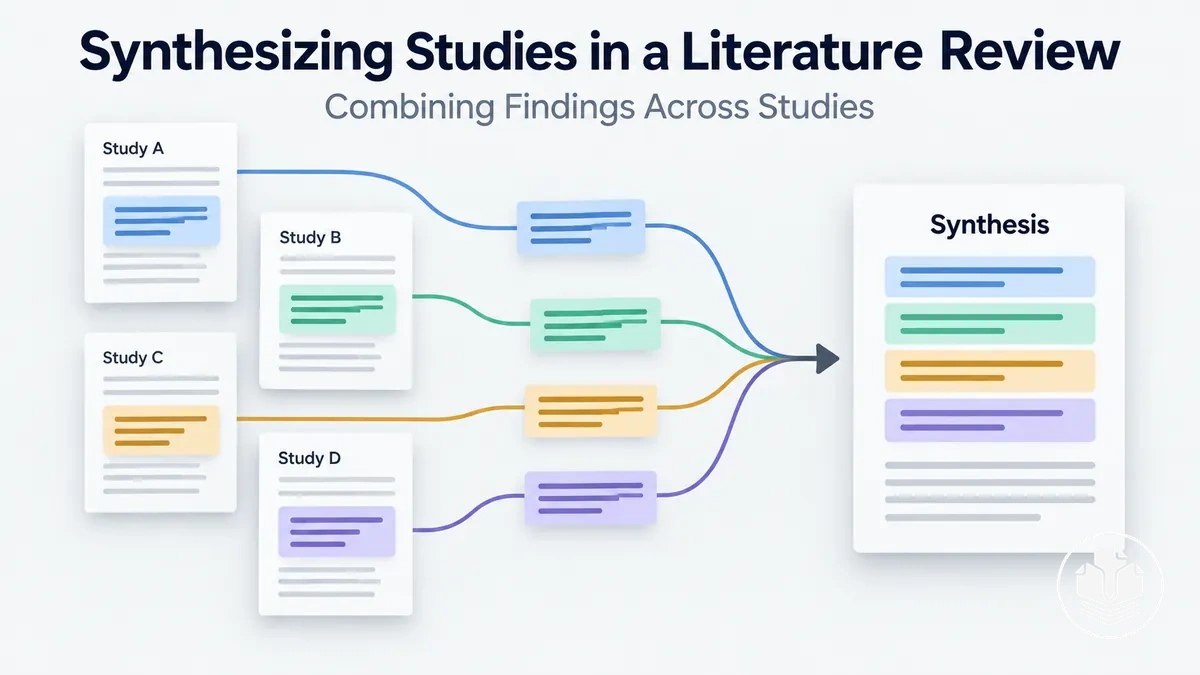
Cross-study synthesis at a glance
Use the review question as the comparison anchor, then move through four linked stages. Each stage produces the evidence relationship needed for the next.
- 1PrepareRecord relevant findings and the attributes that affect comparison: construct or outcome, population, setting, design, measurement and timeframe.
- 2CompareIdentify convergence, divergence, complementarity and condition-dependent variation only across evidence that is sufficiently comparable.
- 3InterpretTurn those relationships into a collective claim, attaching the conditions, exceptions and uncertainty that limit what the pattern supports.
- 4VerifyCheck relevant support, contrary findings, claim-to-evidence fit and whether the writing has slipped back into one-study-at-a-time reporting.
Decision rule: if two findings are not sufficiently comparable, do not treat their difference as a direct conflict; keep the distinction visible or synthesize it conditionally.
Comparability is the immediate prerequisite for meaningful synthesis: shared terminology can hide different constructs or conditions, while different methods can still produce evidence that is comparable for the review question.
Table of Contents
Prepare Studies for Direct Comparison
Comparable studies require a common basis before their findings can be synthesized.
Define that basis from the review question, then record the study attributes that materially affect comparison, such as population, setting, design, outcome, measurement, and relevant findings.
The appropriate comparison dimensions depend on the review question and the designs of the included studies; comparability does not require the studies to use identical methods.
The preparation sequence below creates a consistent evidence record for synthesis while keeping meaningful differences visible.
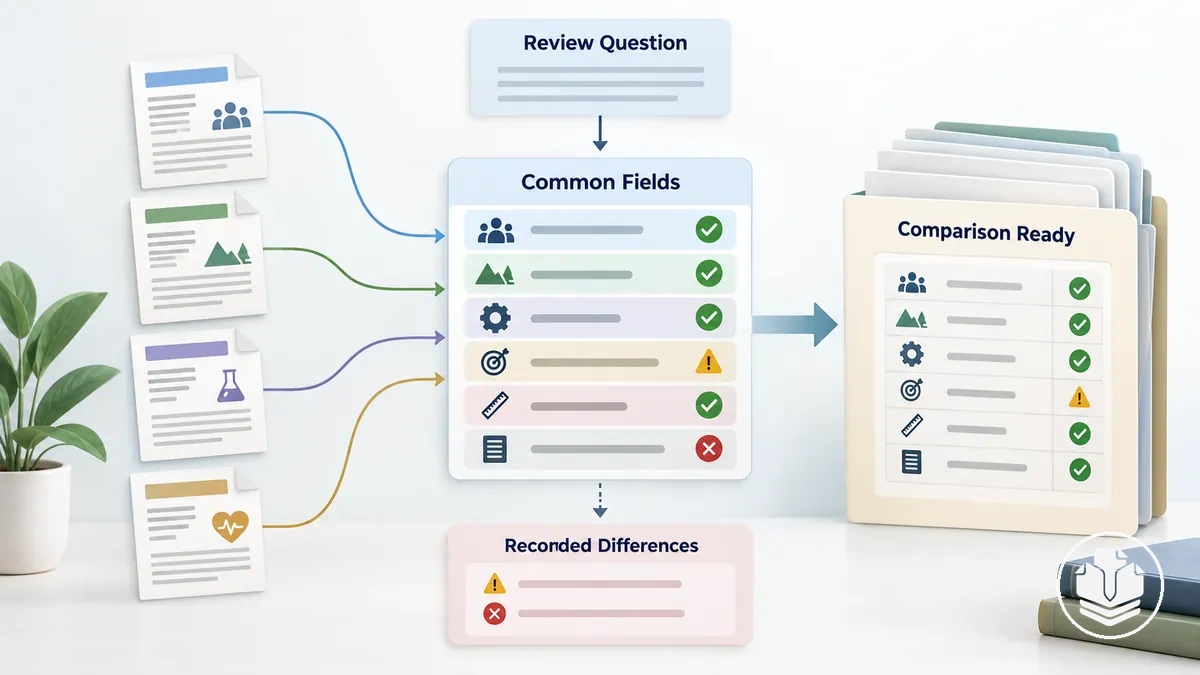
- Identify the review question. Use the question to determine which findings and study attributes are relevant to the synthesis.
- Select relevant findings. Retain findings that address the same review question or a genuinely comparable sub-question rather than grouping results only because they share similar terminology.
- Define common comparison points. Choose evidence fields that matter to the question, such as population or sample, setting, design or method, outcome or construct, and measurement approach.
- Record the evidence consistently. Capture the relevant findings and comparison dimensions in the same evidence-recording fields for each study so corresponding information can be examined together.
- Flag missing or non-equivalent information. Mark attributes that are unreported or not directly comparable instead of treating them as equivalent.
Mismatched outcomes, populations, methods, measurements, or settings can weaken direct comparison because an apparent difference in findings may reflect a difference in what was studied or how it was measured.
General source management should remain separate: organize the literature before applying this synthesis-specific preparation.
For direct comparison, the review question and relevant findings must align; design, setting, population, and measurement may differ, but those differences should be recorded when they affect interpretation.
Missing or non-equivalent study attributes should remain explicit limitations in the evidence record rather than being silently harmonized.
This preserves the conditions attached to each finding and helps distinguish evidence that can be compared directly from findings that require qualification or separate treatment before cross-study comparison.
Revise the Scope Only When New Information Changes Its Feasibility or Coherence
Revise the scope when new information materially changes the feasibility or coherence of the established boundary, not merely because adjacent material is interesting.
Scope decision
Revise the boundary when
- the current scope yields too little relevant literature to address the review question;
- an important part of the review question cannot be addressed within the boundary; or
- the included evidence no longer forms a coherent basis for synthesis.
Action: change only the affected boundary, document the reason, then re-check evidence coverage and workload.
Keep the boundary stable when
An adjacent topic is merely interesting but does not change the review's feasibility or coherence. Expanding for that reason is scope creep rather than a synthesis requirement.
Example: too little relevant literature may justify reassessing the population, period or conceptual boundary; peripheral material alone does not.
Set Common Comparison Points Across the Studies
Comparison points are shared dimensions applied consistently across studies so similarities and differences can be interpreted on a defensible basis.
Relevant comparison dimensions can include design, population, setting, construct or outcome, measurement, timeframe, and key result, but a dimension should be retained only when it affects interpretation for the review question.
The studies do not need identical methods or measures; the chosen dimensions need to support a meaningful relationship across their evidence.
Applying the same filtered attributes across sources makes the comparison basis visible without turning data collection into an inventory of every available study field.

- Construct or outcome: check whether studies address the same concept or outcomes that can be meaningfully related; differences can limit what apparent agreement or disagreement represents.
- Population: record participant or sample characteristics that affect whether findings concern comparable groups and how broadly a pattern may apply.
- Setting: retain environmental, institutional, geographic, or other contextual conditions when they can qualify the applicability of findings across studies.
- Design: distinguish relevant study designs because differences in how evidence is generated can affect how findings should be interpreted together.
- Measurement: note how the construct or outcome was measured when different measures capture meaningfully different aspects of it; identical measures are not required when the relationship remains defensible.
- Timeframe: retain the period, follow-up interval, or observation window when timing can affect the basis on which findings are compared.
- Key result: record the result relevant to the review question together with the conditions needed to interpret it, rather than treating isolated result statements as directly equivalent.
Core comparison points are the shared dimensions needed to establish conceptual and outcome alignment across the studies; context-dependent comparison points are attributes such as setting, design, measurement, or timeframe when those conditions materially qualify interpretation.
Relevance to the review question determines which analytical fields belong in either group.
A common comparison dimension contributes to explaining or qualifying a cross-study pattern, whereas an available data field with no interpretive consequence does not need to be retained.
Use a Synthesis Matrix to Map Comparable Findings
A synthesis matrix is a table that organizes studies against common themes or comparison dimensions so relationships among findings become visible before prose is written.
It maps comparable evidence across sources, making agreement, divergence, potential patterns, contradictions, and gaps in comparability easier to inspect.
These visible relationships are starting points for interpretation rather than conclusions produced by the matrix itself.
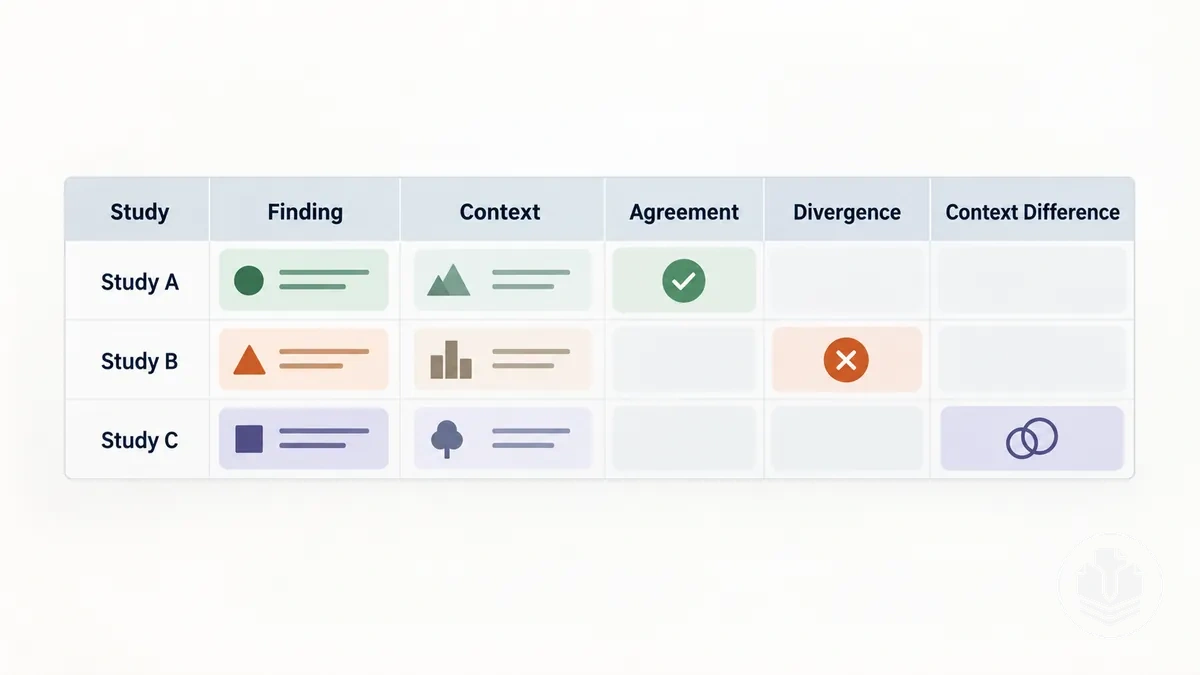
| Study | Theme or Comparison Dimension | Relevant Finding | Method or Context Condition | Relationship to Other Studies |
|---|---|---|---|---|
| Study A | Outcome | Improvement reported for the outcome under review | Outcome assessed after the intervention | Agreement with Study B on the direction of the finding |
| Study B | Outcome | Improvement reported under a different study condition | Different population and measurement approach | Similar direction to Study A; context limits direct equivalence |
Record one concise evidence entry for each relevant study-theme or study-dimension relationship, including the relevant finding, the method or context condition needed to interpret it, and notes on agreement or divergence with other studies.
Keep each entry analytical and source-specific rather than copying passages from the study; the example rows above are illustrative rather than factual study findings.
A synthesis matrix supports interpretation by externalizing comparable evidence, but it is not the finished synthesis and does not replace analytical judgement.
Compare Findings Across Studies
Compare study findings on a shared basis such as the same review question, construct, outcome, or other relevant comparison dimension before interpreting similarities or differences.
Findings may align, diverge, or vary conditionally, but the relationship is meaningful only when differences in context, methods, samples, and measures are kept visible.
Cross-study comparison therefore converts isolated findings into explicit relationships rather than treating each study as a separate summary.
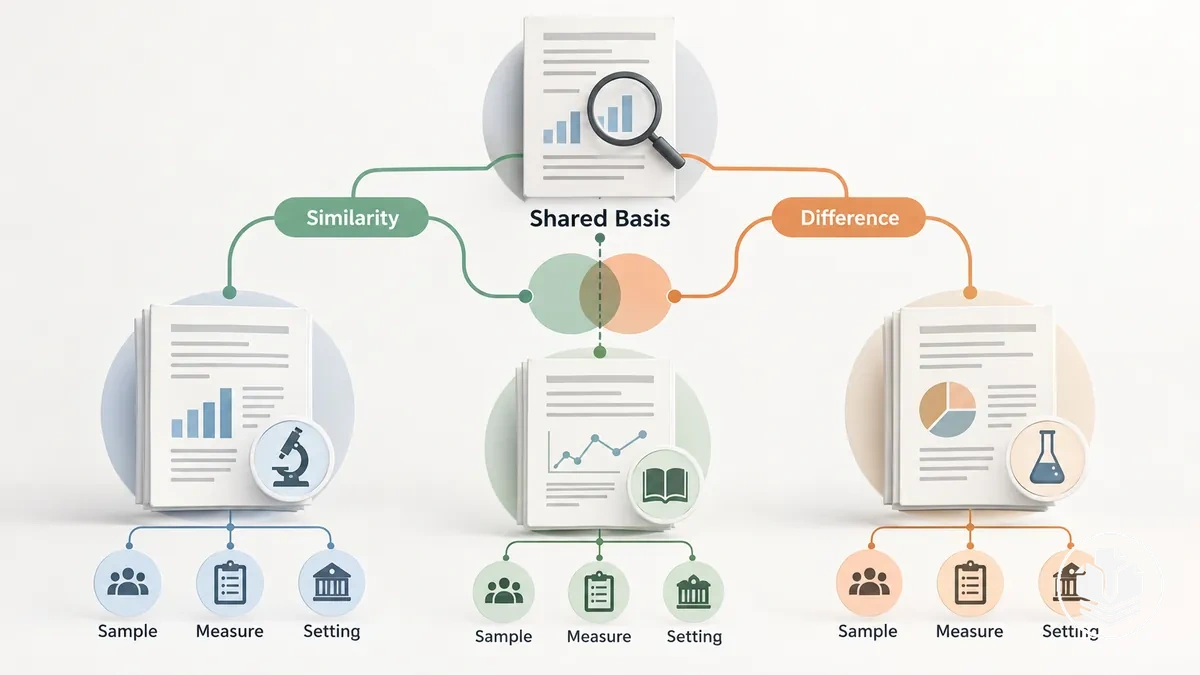
Similarity or convergence exists when comparable findings point in the same direction under sufficiently related conditions, while divergence exists when comparable findings differ in direction, magnitude, interpretation, or reported outcome.
For example, two studies may report the same nominal outcome but differ because one uses a different sample or measure; if those conditions materially affect interpretation, the difference should be described as contextual rather than treated as a direct contradiction.
A shared topic alone is not enough to establish that two findings are directly comparable.
Methodological differences matter only when they change how the findings should be interpreted.
Differences in methods, samples, measures, or settings can qualify applicability, explain apparent variation, or limit direct comparison without making one study inherently weaker.
Record the observed cross-study relationship first, then reserve the higher-order interpretation of what that relationship means collectively for the later synthesis stage.
Identify Recurring Themes, Patterns, and Areas of Agreement
Recurring themes and patterns are repeated relationships supported by findings from more than one study on a meaningful comparison basis.
A theme is supported when relevant studies converge around a shared concept, relationship, or outcome under conditions that make the findings sufficiently comparable.
Agreement indicates alignment across those findings, but recurrence alone does not establish the importance or generality of the pattern.
Meaningful thematic convergence depends on the relationship represented by the findings, not merely on similar wording.
For example, differently worded findings may form one thematic grouping when they indicate the same relationship between a condition and an outcome in comparable contexts.
By contrast, repeated terminology can suggest only superficial similarity when the studies examine different constructs, populations, measures, or conditions.
- Theme supported by a shared relationship: findings from multiple studies align around the same underlying relationship under sufficiently comparable conditions, allowing the pattern and its implication for the review question to be stated with appropriate qualification.
- Theme suggested only by similar wording: findings use related terms but represent different relationships or conditions, so wording similarity alone does not support a common thematic implication.
A validated pattern indicates where the evidence converges and provides a basis for explaining what that agreement implies for the review question, with its scope limited by the studies and conditions that support it.
Identified patterns can also inform thematic and chronological organization of the evidence, but choosing between those organizational approaches is a separate task from identifying the themes themselves.
Explain Differences in Results, Methods, Samples, and Contexts
Differences across studies should be interpreted through study attributes that could plausibly change how the results are understood.
When a study difference matters
- Interpretively material
- A difference changes what was studied, how the outcome was assessed, or the conditions to which the finding applies. It may therefore change meaning, applicability or comparability; for example, non-equivalent samples or measurements can limit a direct comparison.
- Descriptive only
- A methodological or contextual difference exists but has no demonstrated interpretive consequence. Keep it neutral rather than treating the difference itself as an explanation.
- Opposing result
- Treat opposing findings as a direct conflict only when they remain sufficiently comparable. Otherwise, describe the difference as contextual, condition-specific or non-equivalent rather than forcing a contradiction.
A contextual or methodological difference can be a plausible contributor to divergence without proving why the results differ.
Develop a Cross-Study Interpretation From the Evidence
A synthesis should state what the studies indicate together, not merely what each study reports.
Cross-study interpretation converts relationships already identified in the evidence into a cross-study claim supported by the findings.
Relationship → synthesis implication
- Agreement
- Comparable findings point toward the same conclusion, supporting a shared interpretation within the conditions represented by those studies.
- Complementarity
- Different findings support distinct aspects of the same interpretation; the findings need not be identical to contribute to one collective claim.
- Divergence or condition dependence
- The collective claim needs qualification when comparable findings differ or when a pattern holds only for particular populations, settings, methods or measurement conditions.
- Unresolved tension
- Keep the disagreement explicit when the evidence does not support a defensible explanation or one integrated conclusion.
Boundary: an evidence-supported interpretation follows relationships visible across the compared findings. An inference that goes beyond those relationships requires qualification; consistent findings do not by themselves establish a universal mechanism.
State What the Studies Show Collectively
The body of studies should be stated collectively as the strongest pattern that the evidence supports rather than as a sequence of individual findings.
A collective finding may indicate that the studies converge on a shared pattern, support it only under particular conditions, or remain mixed when the findings do not align sufficiently.
The claim should therefore include the main condition or exception whenever leaving it out would overstate what the evidence supports.
The practical or conceptual implication should follow from that collective pattern, not from an unsupported inference.
When the findings generally align under comparable conditions, the evidence can support a qualified conclusion such as that the pattern appears consistently within those conditions; when important exceptions remain, the conclusion should state them explicitly rather than imply consensus.
This keeps the implication proportional to the evidence and distinguishes what the study set collectively supports from what still requires further qualification.
Explain Which Conditions Change the Pattern
A synthesized pattern may change across population characteristics, setting, design, measurement, timeframe, or exposure conditions when those study attributes alter how the findings should be interpreted.
Conditional synthesis therefore asks where the pattern holds, where it weakens or changes, and whether its applicability is limited to particular conditions.
The presence of a difference alone is not enough; the condition must have a plausible interpretive consequence for the collective finding.
- Population or sample: differences in participant or sample characteristics may limit whether the same pattern applies across groups, so the interpretation should specify the population conditions supported by the evidence.
- Setting: a pattern observed in one institutional, geographic, social, or environmental setting may have limited applicability in another when context differs in ways relevant to the finding.
- Design: differences in design may alter interpretation when they change how evidence is generated or the basis on which findings are compared; design variation should remain descriptive when no interpretive effect is demonstrated.
- Measurement: different measurement approaches may change the observed state of the pattern when they capture different aspects of the construct or outcome, which can limit direct comparability.
- Timeframe: differences in observation period, follow-up duration, or timing may be associated with changes in the observed pattern, so applicability should remain tied to the timeframe represented by the studies.
- Exposure or study condition: differences in the level, duration, or form of the relevant condition may be associated with changes in the pattern, but they should not be described as causal unless the underlying evidence supports that relationship.
A condition materially changes interpretation when it alters the meaning, scope, or applicability of the synthesized pattern; a background difference with no demonstrated interpretive effect should remain descriptive rather than explanatory.
Each retained condition should therefore connect explicitly to the state of the pattern and to its implication for interpretation or applicability.
This keeps conditional claims proportionate to the evidence without treating every observed study difference as a condition that matters.
Synthesize Conflicting Findings Without Forcing Agreement
Conflicting findings should not be forced into agreement because observed disagreement may represent either a genuine evidence conflict or an apparent conflict created by differences in comparability.
Test whether the opposing results address sufficiently comparable questions and conditions before interpretation, then use the diagnostic flow to move from the conflicting result through comparability and plausible explanation to a qualified synthesis.
- Conflicting result: preserve each study's reported finding and state the disagreement without deciding that one result is correct.
- Comparability check: determine whether the findings concern sufficiently comparable outcomes and conditions for the disagreement to represent a direct conflict.
- Plausible explanation: examine whether relevant differences in methods, population, measurement, context, timing, analytical choices, or other material conditions may explain why the findings diverge, without assuming that any one difference causes the divergence.
- Qualified synthesis: state whether the evidence supports a conditional interpretation or whether the conflicting findings remain unresolved, preserving the resulting uncertainty.
Comparability determines how the disagreement should be synthesized.
If findings are directly comparable, plausible methodological or contextual differences may help explain their divergence, but an explanation should remain conditional unless the evidence establishes the relationship.
If a material condition separates the studies, an apparent conflict may become conditional agreement: for example, opposing results can support different condition-specific patterns when the studies examine different populations or measurement conditions.
The resulting qualified synthesis should state both the shared interpretation and the condition that limits it rather than force consensus.
Apparent conflict can be reconciled when a material difference in methods, population, measurement, or context makes the findings compatible under different conditions.
Genuine unresolved conflict remains when sufficiently comparable findings still diverge and the available evidence does not support a defensible explanation.
In that case, the synthesis should preserve the disagreement and uncertainty rather than select a winner, with the next step being a closer comparability check.
Check Whether Opposing Results Are Directly Comparable
Opposing results are directly comparable only when they address the same construct under sufficiently similar conditions for a direct contrast to be meaningful.
Comparability should therefore be checked across the outcome definition, population, measurement, timeframe, setting, and design features that materially affect interpretation.
Shared terminology does not establish that two studies represent the same construct, while a difference in method does not automatically make their findings non-comparable.
- Review question and construct: findings that address the same review question and represent the same underlying construct support direct contrast; a material difference in what is being investigated requires separate interpretation.
- Outcome definition: opposing findings support a contradiction claim only when their outcomes represent sufficiently equivalent states or effects; materially different outcome definitions weaken that claim even when similar labels are used.
- Population: results from sufficiently comparable populations can support direct contrast, while a population difference that changes the scope or applicability of the finding may require separate interpretation.
- Measurement: different measurement approaches can remain comparable when they represent the same construct adequately for the review question; measurement that captures materially different aspects of the outcome weakens direct comparability.
- Timeframe and setting: findings observed across sufficiently related periods and contexts can be contrasted directly, while a timeframe or setting difference that materially changes the condition represented by the finding may require separate interpretation.
- Design: design differences matter when they change the basis on which the opposing results can be interpreted; a methodological difference with no material consequence for the comparison does not by itself prevent direct contrast.
Material non-equivalence weakens a contradiction claim because opposite directions do not necessarily represent disagreement about the same evidence relationship.
For example, two studies may report opposing results while examining different populations or defining the outcome differently; in that case, the findings may represent condition-specific patterns rather than a direct contradiction.
Results that remain sufficiently comparable after this check can then be investigated for plausible sources of disagreement.
Explain Plausible Sources of Disagreement Across Studies
Sources of disagreement across comparable studies may reflect several plausible mechanisms rather than one certain cause.
Documented differences in sampling, population, design, measurement, operationalization, setting, timing, analysis, or uncertainty can provide candidate explanations when those differences could affect the observed results.
Their presence does not establish that they produced the divergence, and the available study information should determine which explanatory factors warrant consideration.
- Population and sampling: differences in the population studied or in how participants or cases were sampled may contribute to different results when the relevant characteristics or resulting samples differ in ways connected to the outcome.
- Design, measurement, and operationalization: differences in design can change how evidence is generated, while measurement or operationalization differences may represent different aspects of the same construct; either condition could help explain divergence in the observed findings when it affects interpretation of the outcome.
- Setting and timing: differences in setting may reflect different contextual conditions, while differences in timing or observation periods may capture the outcome under different circumstances; these conditions may contribute to disagreement when the pattern is context- or time-dependent.
- Analysis and uncertainty: different analytical choices may produce different interpretations or estimates from otherwise related evidence, while sampling variation, measurement uncertainty, or other documented uncertainty may leave some divergence unresolved rather than support a substantive explanation.
The most plausible explanation is the explanatory class supported by a documented study difference and a defensible connection between that difference and the observed result, not simply any difference present between studies.
More than one contributing condition may remain plausible, and the available evidence may be insufficient to distinguish their relative importance.
These factors should be described as possible contributors or associations unless the evidence demonstrates that a particular mechanism caused the disagreement.
Preserve Uncertainty When the Evidence Cannot Be Reconciled
Unresolved disagreement should remain visible in the synthesis when the available evidence does not support a defensible reconciliation.
Preserve the competing findings, state what the evidence supports, and add a qualification that identifies what remains uncertain rather than forcing the conflict into false consensus.
The resulting bounded conclusion should distinguish the established evidence state from claims that cannot be resolved from the available evidence.
Uncertainty because evidence conflicts differs from uncertainty because studies examine different conditions.
When comparable findings point in opposing directions, the direction of the overall pattern may remain uncertain; when findings differ in size, the magnitude may be uncertain even if their direction aligns.
Differences across population or context may support only a condition-specific conclusion, while an unsupported explanation for the divergence leaves the mechanism uncertain.
The synthesis can therefore state the observed findings and their supported conditions, but it should not claim a single direction, magnitude, population-wide pattern, contextual generalisation, or mechanism when the evidence does not establish it.
Verify That the Synthesis Is Balanced and Evidence-Based
A balanced, evidence-based synthesis represents the relevant evidence proportionately, keeps each major cross-study claim traceable to its support, and makes conditions and limitations visible.
Verification checks whether the synthesis is genuinely cross-study rather than a sequence of source summaries and whether contrary findings are represented where they materially affect the interpretation.
Balance means proportional and traceable representation of the evidence, not equal space for every study.
Unequal evidence does not require artificial equal treatment.
A recurring pattern supported across relevant studies may warrant greater emphasis than an isolated finding, while contrary findings still need to remain visible when they qualify the conclusion.
The checklist verifies claim-to-evidence alignment, proportional representation, qualification, and whether the synthesis has drifted back into source-by-source reporting.
- Cross-study support: check whether each major cross-study claim is supported by findings from multiple relevant sources where the evidence base permits it; a claim resting on one study should not be presented as a collective pattern.
- Contrary findings: confirm that relevant contrary findings are represented when they materially qualify or challenge the synthesized conclusion rather than being omitted for convenience.
- Visible conditions: retain population, setting, design, measurement, timeframe, or other conditions when they limit where the synthesized pattern applies.
- Visible limitations: state unresolved disagreement or evidence limitations when they restrict confidence in the interpretation instead of presenting a stronger conclusion than the evidence supports.
- Claim-to-evidence alignment: verify that the scope and certainty of each claim match the findings used to support it, including any necessary qualification.
- No source-by-source drift: check that the synthesis relates findings across studies rather than returning to a sequence of separate study summaries.
A failed check requires targeted revision of the affected claim, qualification, or evidence relationship rather than expansion into unrelated editing tasks.
Once the synthesis logic passes these checks, the next step is to write literature review paragraphs that express the verified cross-study interpretation clearly.
Verification is complete when the synthesis represents the evidence proportionately, remains traceable to relevant support, and preserves necessary conditions and limitations.
Check for Source-by-Source Summary Instead of Cross-Study Synthesis
A source-by-source summary occurs when the writing reports one study after another without stating an explicit cross-study relationship.
An author-by-author structure dominated by reporting verbs such as “found,” “reported,” or “argued” can signal this error when the sentences never compare, combine, or interpret the findings together.
Recognition and correction
- Repeated one-source-at-a-time sentences leave the reader to infer how findings relate.
- Reporting verbs such as “found”, “reported” or “argued” do not create synthesis unless the writing also compares, combines or interprets the evidence.
- Reorganize around an explicit cross-study relationship; transitional words alone are not enough.
Before: source-by-source
“Study A reports one finding. Study B reports another finding. Study C reports a third finding.”
After: cross-study synthesis
“Across the three studies, the findings converge on one pattern under comparable conditions, while one result differs under a distinct condition that qualifies the synthesis.”
Descriptive source reporting can be useful when a study-specific detail must first be established, but analytical synthesis requires the writing to compare or combine findings through an explicit cross-study relationship.
This distinction also separates summary from the broader task of how to write critical analysis, where evidence is evaluated and interpreted rather than merely reported.
Check That Major Claims Draw on Multiple Relevant Studies
A major cross-study claim should reflect the relevant evidence base rather than rely on a convenient single source when several studies directly address the claim.
The supporting studies should bear on the same relationship or interpretation represented by the claim and remain connected to any conditions that limit their applicability.
The check therefore tests evidence coverage and evidentiary fit rather than raw citation volume.
The checklist separates evidence coverage from claim qualification so that each claim can be evaluated against the studies that actually support or challenge it.
- Evidence coverage — relevant studies: check whether the claim draws on the relevant studies that directly bear on it; when several studies address the relationship, relying on only one may omit evidence needed for a cross-study interpretation.
- Evidence coverage — contrary evidence: check whether materially contrary evidence is acknowledged when it affects the collective pattern; omitting relevant disagreement can overstate the support for the claim.
- Claim qualification — conditions: verify that population, setting, design, measurement, timeframe, or other material conditions remain attached to the claim when they restrict where the evidence applies.
- Claim qualification — evidence fit: confirm that the scope and certainty of the claim match its evidentiary support; mixed or condition-dependent evidence requires corresponding qualification rather than a broader conclusion.
Evidence coverage becomes misleading when citation quantity is treated as a substitute for relevance or evidentiary strength.
A single study may be the only genuinely relevant evidence for a particular claim, while several citations may still provide poor support if they do not directly address it.
Verification should therefore judge each citation by its relevance and fit with the claim, not impose a mechanical citation-count rule.
Keep Important Exceptions and Limitations Visible
Important exceptions and limitations should remain attached to the synthesized claims they qualify so that confidence and applicability are not overstated.
A material exception, boundary condition, measurement constraint, or methodological limitation changes how broadly or confidently a claim can be interpreted.
The verification task is therefore to identify only those qualifications that materially alter the evidence state rather than create a generic limitations inventory.
The checklist separates limitations that change the synthesized claim from background limitations with little effect on the current conclusion.
Each retained item should identify the affected claim and explain whether it narrows applicability, reduces confidence, or leaves part of the interpretation uncertain.
A reported constraint should therefore remain visible only when it materially changes how the synthesized evidence can be interpreted or applied.
- Counterexample or exception: retain a material counterexample when it qualifies the dominant pattern; the affected claim should be narrowed rather than presented as universally applicable.
- Underrepresented context: when relevant populations, settings, or conditions are sparsely represented, qualify the claim so its applicability does not extend beyond the contexts supported by the evidence.
- Measurement constraint: when measurement captures only part of the construct or limits comparability, reduce confidence in claims that depend on broader or more precise interpretation of that outcome.
- Methodological limitation: preserve a reported design or method limitation when it materially constrains the inference supported by the study set; background limitations with little effect on the synthesized claim need not dominate the interpretation.
- Unresolved uncertainty: when an important aspect of the evidence remains uncertain, keep that qualification visible in the claim rather than converting the uncertainty into a stronger conclusion.
Repeated limitations or persistent missing evidence may define an evidence boundary that warrants separate analysis, but they do not automatically establish a research gap.
When those constraints materially shape what the literature can address, the next task may be to identify research gaps rather than extend the limitations checklist into a full gap-analysis process.