
Building a Literature Review Search Strategy
A literature review search strategy turns a defined review question into searchable concept groups, develops free-text and controlled-vocabulary terms for those concepts, combines alternatives with OR and distinct required concepts with AND, then adapts, tests, and documents the search in each database. Preserve the meaning and scope of the question while allowing fields, subject headings, operators, limits, and syntax to change when the database or review method requires it.
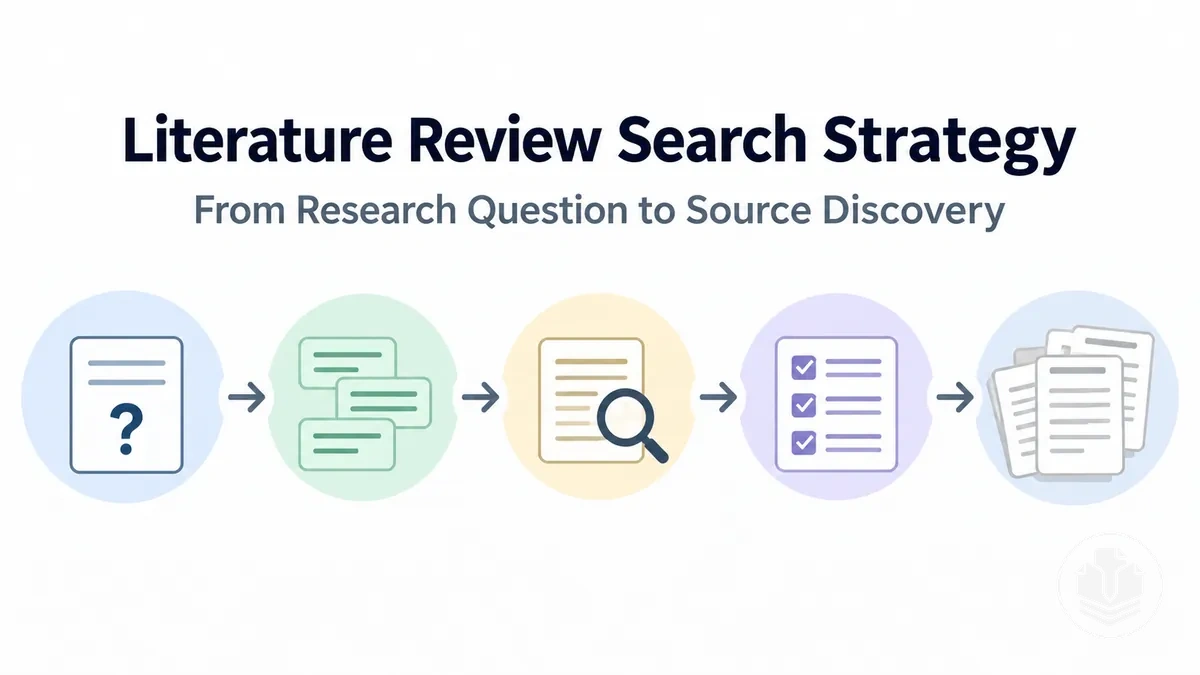
At a glance
Build the search strategy through six linked decisions
Each stage converts one part of the review question into a search decision. Keep the conceptual meaning stable; adapt the implementation to the database and review method.
-
1
Question → searchable conceptsRetain the substantive ideas needed to represent the information need; do not make every word a mandatory search block.
-
2
Concepts → term setsUse relevant free-text wording and, where available, database-specific controlled vocabulary for the same concept.
-
3
Term sets → Boolean structureUse OR for legitimate alternatives within one concept and AND between distinct concepts that the search must represent.
-
4
Strategy → database implementationSelect databases that fit the topic and method, then translate fields, subject headings, operators, and syntax without changing the conceptual logic.
-
5
Retrieval → controlled refinementInspect missing relevant papers and recurring irrelevant results, then change one variable or a small linked set of variables and rerun the search.
-
6
Execution → traceable search recordRecord the database or platform, exact query, date, fields, filters or limits, useful result counts, and substantive revisions.
- Keep stable
- Review scope, concept meaning, and the logical relationship between concepts.
- Adapt
- Search terms, subject headings, field codes, operators, filters, and platform syntax when the search environment requires it.
- Verify
- Whether retrieval still represents the question, then preserve the exact conditions under which the search was run.
The level of documentation and reproducibility should match the review method: systematic reviews generally require a more transparent and reproducible search process than less formal reviews. In every case, begin by identifying which parts of the review question must become searchable concepts.
Table of Contents
Translate the Review Question into Searchable Concepts
An established review question should be reduced to a focused set of searchable concepts rather than entered into a database word-for-word.
Searchable concepts are the substantive ideas that carry the meaning of the research topic and can later be represented by appropriate search terms.
The number of concept groups depends on the question and review method; retaining only concepts necessary to represent the information need avoids making every word a mandatory search block.
Identify substantive nouns or concept groups that materially define the population or topic, intervention, exposure, outcome, context, or other boundaries relevant to the question, while excluding connective wording that does not need its own search block.
This decomposition assumes that you have already formulated the research question and are now translating its meaning into database-searchable units.
Frameworks such as PICO can help identify concept groups when they suit the review method and question type, but PICO is not a universal requirement for literature searching.
The following sequence separates the conceptual meaning of the question from the search syntax that will be developed later:
- Identify the substantive concepts that carry the meaning of the review question.
- Test whether each concept must be represented for the search to preserve the intended information need.
- Remove connective wording and concepts that would unnecessarily constrain retrieval.
- Verify that the remaining concept groups still represent the question before developing search terms for them.
For example, the illustrative review question “How does remote work affect job satisfaction among software developers?” can be separated into remote work, job satisfaction, and software developers, while connective wording such as “how does” does not need its own concept group.
Which of these concepts must remain in the search should reflect the boundaries established when you define the review scope.
 These concept boundaries determine which groups of search terms are developed later, so each retained group should represent a distinct part of the information need.
Develop Keywords and Search Terms for Each Concept
Search terms for each concept are the words and phrases used to represent that concept in a literature search.
A useful term set can include free-text keywords, synonyms, spelling variants, abbreviations, phrases, and relevant subject headings or other controlled vocabulary.
These forms account for differences between author language and the indexing language used by a database.
Each candidate term should remain tied to the meaning of its parent concept rather than being included only because it is loosely related to the broader research topic.
Candidate search terms can be gathered from terminology used in relevant titles, abstracts, keywords, and indexing fields, as well as from the controlled vocabulary available in the database.
These sources expose different linguistic representations of the same concept and provide candidate wording to evaluate rather than terms that must automatically be included.
 Free-text terms reflect language used by authors, while subject headings and other controlled vocabulary reflect standardized indexing terminology where the database provides it.
Spelling variants, abbreviations, phrases, and synonyms may also represent the same concept, but their relevance should be checked before they become part of the search strategy.
Evaluate each candidate by asking whether it still represents the same concept closely enough to support relevant retrieval.
Retain useful keywords, synonyms, spelling variants, abbreviations, phrases, and controlled-vocabulary candidates, while pruning wording that introduces a different concept or only a remote association.
Terminology discovered in relevant records or indexing can refine the candidate set, but each addition should remain connected to its parent concept.
Term development produces a focused set of search terms for each concept; combining those terms into search syntax belongs to the later search-construction stage.
Use Free-Text Keywords, Synonyms, and Terminology Variants
Free-text keywords represent the natural language authors may use for a concept in titles, abstracts, keywords, or other searchable fields.
Because authors can express the same concept with different wording, useful free-text terms can include synonyms, spelling variants, abbreviations, acronyms, and phrase variants.
Each variant should still represent the same underlying concept rather than a loosely related idea.
Alternative wording is easier to evaluate when each variant is grouped by its relationship to the parent concept.
The image groups several forms of author language that can refer to the same concept without turning the alternatives into an unrestricted keyword cloud.
 For the illustrative concept remote work, candidate free-text variants can be classified as follows:
- Synonym: telework.
- Spelling variant: telework and tele-work, when both forms occur in the literature being searched.
- Abbreviation or acronym: include one only when authors use it for the same concept and its meaning is sufficiently specific in the search context.
- Phrase variant: working from home, when it represents the intended concept within the review scope.
An added variant may retrieve records that use different author language and can therefore broaden recall.
A broader term can retrieve records outside the intended concept, while a narrower term can represent only part of that concept, so relevance can change as the wording changes.
Candidate free-text terms should therefore be retained for conceptual fit rather than merely because they are topically associated.
Include Relevant Subject Headings and Controlled Vocabulary
Controlled vocabulary uses standardized terms to represent concepts during database indexing, while subject headings are the controlled terms assigned within a particular vocabulary system.
These terms can differ from the free-text language authors use in titles and abstracts.
Using relevant subject headings alongside free-text keywords can therefore represent the same concept through both author wording and indexing language.
Subject headings must be interpreted within the database and vocabulary in which they are used because their terminology and hierarchy are database-specific.
A heading may sit beneath a broader term or above narrower terms, and an expansion or explosion option may include narrower indexed concepts when the database supports that behavior.
The image clarifies how author wording and a standardized indexed term can represent the same search concept within a database-specific vocabulary.
 Expansion can broaden retrieval through relevant narrower headings, but expanding a heading beyond the intended concept can also introduce less relevant records.
Relevant headings and expansion settings should therefore be checked against the database's own vocabulary and hierarchy rather than assumed to transfer unchanged to another database.
For example, heart attack can be searched as free-text author wording, while the corresponding MeSH heading is Myocardial Infarction.
The U.S. National Library of Medicine's MeSH vocabulary identifies Myocardial Infarction as a descriptor, so that subject heading can represent records indexed to the concept even when their author wording differs from the free-text phrase.
MeSH illustrates the complementary role of controlled vocabulary, but another database may use a different indexing vocabulary or subject heading for the same concept.
Combine Search Terms into a Boolean Search Strategy
A Boolean search strategy combines search terms according to the conceptual relationships between them, turning separate term sets into one coherent search string.
Boolean operators specify whether terms represent alternatives within the same concept group, different concepts that must intersect, or an exclusion.
Parentheses keep each concept group logically distinct so the intended relationships remain explicit and reproducible.
OR usually combines alternative search terms within the same concept group, while AND connects different concept groups.
OR broadens a concept group by allowing records that match any listed alternative, whereas AND requires the separate concepts to occur together under the database's search rules.
The diagram shows this within-concept OR logic and the between-concept AND relationship before they lead to retrieved records.
 NOT excludes records matching a specified term and should be used cautiously because a relevant record may contain both the wanted concept and the excluded term.
The actual retrieval effect also depends on the selected search terms, indexing, searchable fields, and database behavior.
For example, the search string (remote work OR telework OR working from home) AND (job satisfaction OR employee satisfaction) contains two concept groups: the first groups alternative terms for remote work, and the second groups alternative terms for job satisfaction.
OR expresses alternatives inside each set of parentheses, while AND intersects the two distinct concepts.
This Boolean logic can remain conceptually stable when the search is adapted to another database, even though database-specific field codes, controlled syntax, and search functions may require the search string to be translated.
Group Alternative Terms with OR
OR joins alternative terms that represent the same concept, including appropriate synonyms, spelling variants, abbreviations, or equivalent subject terms.
A record can satisfy the concept group by matching any one of those alternatives.
Adding a legitimate alternative broadens the match condition and may increase recall by retrieving records that use different wording.
Broader retrieval does not necessarily produce greater relevance, so each added term should remain conceptually aligned with the same unit.
For example, closely equivalent expressions of remote work can be grouped within parentheses as (remote work OR telework OR telecommuting OR working from home).
Each term is an alternative within the same concept group rather than a separate concept.
Adding telecommuting may recover records that use that wording instead of the other alternatives, thereby increasing recall for that concept.
Terms representing a different concept should not be joined with OR merely to increase retrieval volume.
Connect Different Concepts with AND
AND connects distinct concepts by creating an intersection between their concept groups, so retrieved records must match each connected group.
Requiring multiple concepts often narrows retrieval because records that match only one group no longer satisfy the search string.
This can increase precision when every concept is necessary to the review question, but lower result counts do not by themselves indicate greater relevance.
AND therefore belongs between required concept groups rather than between synonyms or other lexical variants of one concept.
For example, (remote work OR telework) AND (job satisfaction OR employee satisfaction) requires retrieval to represent both the remote-work concept and the job-satisfaction concept, with parentheses keeping the two groups distinct.
Adding another required concept, such as AND (software developers OR programmers), creates a further intersection and can narrow retrieval to records that also represent that population.
The additional concept may improve precision when software developers are an essential boundary of the review question, but it can also exclude otherwise relevant records that do not contain or receive indexing for that concept.
Add an AND-connected concept only when the search needs that concept to define the intended evidence set.
Refine Search Strings with Phrase Searching, Truncation, and Wildcards
Phrase searching targets a multiword expression as an exact phrase or according to the database's phrase-matching rules, often preserving word order more tightly than separate keywords.
Truncation searches from a word stem to capture permitted variants, while wildcards use character substitution to accommodate variation within a term.
The exact symbols and matching behavior depend on the database syntax, so these techniques should be applied according to the search rules of the database being used.
Choose the technique according to the textual variation that the search needs to accommodate.
Each technique changes which forms can match and can therefore broaden or constrain retrieval, but poorly chosen syntax can also introduce irrelevant variants or exclude useful records.
The three techniques address different matching needs:
- Phrase searching: use it for a multiword expression when the words need to be matched together, such as “remote work” when quotation marks are supported for phrase searching. The main risk is excluding records that express the same concept with different wording or word order.
- Truncation: use a supported truncation symbol after a stable word stem to retrieve permitted endings or variants. A word stem that is too short or broad can also match unintended words, so over-truncation can reduce relevance.
- Wildcards: use a supported wildcard symbol for character substitution when spelling variation occurs within a term. The substitution position and number of characters matched depend on the database, so assuming the wrong wildcard rule can change retrieval unexpectedly.
For example, phrase searching can keep “remote work” together when the database supports quotation marks for that purpose, while truncation can expand a suitable word stem to multiple endings under that database's search rules.
If the stem also belongs to words outside the intended concept, those variants may enter retrieval and reduce relevance.
Check the database's documented syntax before applying quotation marks, a truncation symbol, or a wildcard symbol because their symbols and behavior are not identical across databases.
Run and Adapt the Search Across Literature Databases
Run an established search strategy across relevant literature databases by preserving its conceptual logic while adapting its implementation to each search environment.
The required concepts and their relationships should remain stable, but fields, subject headings, operators, filters, and syntax may need database-specific translation.
Conceptual equivalence is the goal; identical search strings or identical retrieval across platforms are not required.
Use a consistent execution sequence so search translation does not change the meaning of the search:
- Select the database: choose a literature database whose subject coverage and search environment are relevant to the review method and topic.
- Translate the syntax: express the same concepts using the database's supported fields, subject headings, operators, filters, and other syntax rather than carrying another platform's query across unchanged.
- Run the search: execute the translated search strategy and observe how the database applies its search rules to the query.
- Perform a basic behavior check: inspect whether the search is retrieving records that represent the required concepts and whether an obvious translation or syntax problem is changing the intended search behavior.
Implementation attributes can vary because literature databases may provide different searchable fields, controlled subject headings, operator conventions, filter options, and result behavior.
A subject heading available in one database may therefore require a different controlled term or a free-text representation in another, while field or operator syntax must follow the rules of the destination database.
These adaptations should preserve the intended concepts without assuming that the databases will return equivalent results.
Further optimization of recall and precision, formal search logging, organization of retrieved sources, and source appraisal belong to later stages rather than this execution check.
Select Databases Relevant to the Review Topic
Database selection should match the review topic, discipline, review method, and the types of evidence that need to be discoverable.
A database is suitable when its subject coverage and search functions support the information need defined by the review question.
The appropriate combination therefore depends on methodological and disciplinary requirements rather than on a fixed database set for every literature review.
Evaluate database suitability against the characteristics that determine whether relevant literature can be searched adequately.
Requirements can change when you choose the review method, because different review methods can require different levels of coverage, transparency, and reproducibility.
Subject coverage and document types determine whether the database contains the kinds of evidence the review needs.
Indexing depth, controlled vocabulary, date coverage, and search functions determine how effectively that evidence can be identified within the database.
- Subject coverage: check whether the database indexes literature from the discipline and topic areas central to the review; weak topical coverage can leave relevant evidence outside the searchable collection.
- Review-method fit: check whether the database supports the coverage and search functions required by the selected review method, particularly when comprehensiveness or reproducibility is important.
- Document types: confirm that the required evidence types, such as journal articles, conference proceedings, reports, or other method-relevant sources, are represented when those sources fall within the review scope.
- Indexing and controlled vocabulary: assess whether the database provides sufficient indexing depth, searchable fields, and controlled vocabulary for the concepts that need to be represented in the search strategy.
- Date coverage: verify that the indexed publication period reaches far enough back, and sufficiently up to date, for the review question and its temporal boundaries.
Suitability can therefore differ across disciplines and review designs: a database with strong biomedical indexing may fit a health-focused review, while a humanities review may require sources with different disciplinary and document-type coverage.
Google Scholar can supplement discovery in some contexts, but it should not automatically replace specialised bibliographic databases when the review method requires systematic coverage and reproducible searching.
Adjust Search Syntax for Each Database
Translate the same conceptual search into the search syntax supported by each database while preserving its meaning.
Field codes, phrase rules, truncation, wildcard symbols, proximity operators, and controlled vocabulary can require different expressions across search environments.
Conceptual equivalence is the goal: the translated search should represent the same concepts and relationships even when the platform syntax differs.
A requirement such as “search this term in the title or abstract” can stay conceptually identical while the database expression changes.
PubMed
- Field tag
[Title/Abstract]- Example
drug overdose[Title/Abstract]
Ovid MEDLINE
- Field expression
ti,ab.- Example
drug overdose.ti,ab.
What stays stable: the term must be searched in title or abstract fields. What changes: the platform-specific field code.
Phrase rules, truncation, wildcard and proximity operator syntax, and controlled-vocabulary mappings may likewise require database-specific translation, so use the destination database's documented syntax rather than assuming another platform's expression applies directly.
Use Google Scholar as a Complementary Search Route
Google Scholar can complement a literature search by supporting broad discovery, citation chasing, and searches for material that may not surface through the same pathways as specialist bibliographic databases.
It supports keyword searching, phrase searching, date filtering, and citation links, but its coverage, ranking, and reproducibility characteristics differ from those of structured database searches.
It is therefore most useful as an additional discovery route rather than as an assumed exhaustive source.
Useful discovery routes
- Locate recent papers and test alternative keywords or phrases.
- Follow Cited by links and related-paper pathways.
- Use date filtering when a recent publication period matters.
What it can add
It can extend discovery beyond the initial database search when terminology or indexing differs, and it can be practical in narrative or exploratory reviews.
Important boundary
Ranking position is not evidence of source quality or complete coverage. When the review method requires transparent, reproducible searching, specialist bibliographic databases usually provide more structured search records, fields, and syntax; treat Google Scholar as a complement rather than a replacement.
Test and Refine the Search for Relevant Coverage
Refine an existing search by assessing whether it retrieves useful relevant coverage without producing excessive noise.
Search refinement balances recall and precision rather than aiming for a fixed result count.
The goal is to understand how a specific search choice changes retrieval and whether that change better represents the review question.
Use a controlled refinement cycle so the effect of each adjustment can be interpreted clearly:
- Inspect: review the baseline search for known relevant papers, recurring irrelevant results, missing terminology, and clues that database indexing may be affecting retrieval.
- Change one variable: adjust a single element, such as adding a legitimate synonym, removing an unnecessary concept block, changing a phrase constraint, or revising a field restriction.
- Rerun: execute the revised search in the same database and under the same relevant conditions so the observed difference can be associated with that one change.
- Interpret: compare the new retrieval with the baseline and decide whether the adjustment improved relevant coverage, reduced irrelevant results, or introduced a new limitation.
Signals of insufficient recall can include known relevant papers that are missing, recurring terminology in relevant records that is absent from the search, or indexing terms that reveal another way the concept is represented.
Weak precision can appear as recurring irrelevant results linked to an overly broad term, unnecessary concept, or permissive matching rule, although the interpretation depends on the topic, database, and review method.
For example, if known relevant papers consistently use telecommuting but the baseline search includes only remote work and telework, adding telecommuting as one controlled change and rerunning the search may increase recall; the observed effect should then be checked for any accompanying rise in irrelevant results.
Retrieval performance is separate from judging whether individual sources are credible or methodologically suitable, which belongs to the later task to evaluate literature review sources.
Adjust the Search When Results Are Too Broad or Too Narrow
A broad search or narrow search is a diagnostic signal rather than proof that the strategy is wrong.
Result volume should be interpreted alongside the relevance pattern: too many irrelevant results may indicate an overly permissive search, while too few relevant results may indicate excessive restriction.
Identify a likely cause, check whether it is actually affecting retrieval, then test a targeted correction rather than changing several variables at once.
If the search is too broad
- Likely causes
- Vague terms, over-truncation, a missing AND intersection, or an overly broad field.
- Check
- Look for terms that recur in irrelevant results and test whether a broad stem or unrestricted field is producing the noise.
- Corrective direction
- Reduce or remove the diagnosed broadening factor. For example, shorten or remove over-truncation only when it is actually retrieving unrelated variants.
If the search is too narrow
- Likely causes
- Missing synonyms, an overly specific phrase, too many AND-connected concepts, restrictive limits, or an exclusion that removes useful records.
- Check
- Inspect known relevant papers for missing terminology, alternative wording, indexing terms, or concepts blocked by the current limits.
- Corrective direction
- Add or relax only the factor supported by the observed retrieval pattern. For example, add telecommuting when relevant papers use it and the current concept group does not.
Do not use a fixed result-count threshold. Change one variable, or a very small linked set of variables, at a time so the effect of the refinement can be interpreted.
Check for Search Errors That Reduce Recall or Precision
A search error can reduce recall, precision, or reproducibility when the query omits relevant terminology, applies search logic incorrectly, or uses database syntax in a way that changes the intended retrieval.
These failures can be conceptual, such as missing terms or inappropriate controlled vocabulary, or technical, such as malformed Boolean grouping or a syntax error.
The effect depends on the database and query, so the error should be recognized from observable search behavior before it is corrected.
The table separates search-construction and execution failures from general literature-review mistakes.
High-value checks include missing free-text terms or controlled vocabulary, malformed Boolean grouping, syntax errors, over-truncation, and unnecessary limits.
Each error can affect recall, precision, or reproducibility differently, so recognition cues should be examined before a correction is applied.
The table links each error class to its likely consequence, an observable cue, and a corrective direction.
| Search error | Likely consequence | Recognition cue | Corrective direction |
|---|---|---|---|
| Missing free-text terms | Recall may fall because records using alternative author terminology are omitted. | Known relevant papers repeatedly use terms that are absent from the query. | Add conceptually valid synonyms or terminology variants and rerun the search. |
| Missing or inappropriate controlled vocabulary | Relevant indexed records may be missed, or precision may weaken if an overly broad subject heading is expanded. | The database thesaurus shows a relevant controlled term that is absent, or subject-heading expansion retrieves concepts outside the intended scope. | Map the concept to the database's controlled vocabulary and review whether expansion should be retained, narrowed, or removed. |
| Malformed Boolean grouping | Retrieval logic can change because operators are applied to the wrong term groups. | A string such as remote work OR telework AND job satisfaction behaves differently from the intended grouped form (remote work OR telework) AND job satisfaction. | Use parentheses to make concept groups and operator relationships explicit. |
| Database syntax error | The query may fail, ignore a field instruction, or execute with unintended behavior. | The platform returns an error message, rewrites the query unexpectedly, or does not apply the intended field code or operator. | Check the database's documented syntax and correct the affected field code, operator, phrase rule, or symbol. |
| Over-truncation | Precision may fall because an overly short word stem retrieves unrelated variants. | Irrelevant results repeatedly contain words that share the truncated stem but not the intended concept. | Use a longer stem, remove truncation, or replace it with more specific terms where appropriate. |
| Unnecessary limits or filters | Recall may fall when relevant records are excluded by date, language, document type, or another restrictive limit. | Known relevant papers disappear only after a limit is applied. | Remove or relax the unnecessary limit and confirm whether the excluded relevant records return. |
| Irrelevant or weakly related terms | Precision may fall because the query admits records outside the intended concept. | Recurring irrelevant results are being matched through the same nonessential term. | Remove or replace the term if it does not represent a required concept in the search strategy. |
Recognition should come before correction: compare the query against known relevant papers, inspect recurring irrelevant results, check the controlled vocabulary, and review the database's parsed or translated search where available.
Correct one identifiable construction error at a time so its effect on retrieval can be interpreted.
This keeps the audit focused on search construction and execution rather than drifting into source appraisal, writing, or synthesis.
Document the Search Strategy for Transparency and Reproducibility
Document the search strategy so the search process remains traceable: record what was searched, where it was searched, when it was run, and under which conditions.
A clear search record supports transparency and may enable reconstruction of the search when enough detail is preserved for the review method.
Record substantive decisions at the time of searching so later versions can be understood without relying on memory.
A practical search log should capture verifiable search conditions and decisions rather than organize the literature retrieved by the search.
Record the exact values used for the database, search string, search date, fields, filters or limits, and result count where that count helps interpret the search.
For each substantive refinement, preserve the version or changed element, the reason for the change, and its observed effect where useful.
The record should be detailed enough to reconstruct the search conditions appropriate to the review method; for example, an illustrative entry could record Database: MEDLINE; Search date: 17 September 2026; Search string: (remote work OR telework OR telecommuting) AND (job satisfaction OR employee satisfaction); Fields: title and abstract; Filters or limits: none; Result count: the count observed when the search was run; Refinement: added “telecommuting” after identifying it as relevant alternative terminology.
- Database or search system: record where the search was executed.
- Search string: preserve the exact query as executed.
- Search date: record when the search was run.
- Fields: identify the searchable fields used.
- Filters or limits: record restrictions that changed the searchable set.
- Result count: record the observed count when it is useful for interpreting that search version.
- Refinement: note a substantive change, its reason, and its observed effect where applicable.
For an ordinary literature review, the search record may only need enough detail to make the process understandable and traceable, while systematic reviews and other evidence-synthesis methods may have stronger reproducibility and reporting requirements determined by the review method or applicable guidance.
Search documentation supports appropriate reproducibility but does not guarantee that another search will return an identical result set, particularly when database contents or indexing change.
Once the search process is documented, the separate next task is to organize the sources that were retrieved.
Record Databases, Search Strings, Dates, and Limits
Record the search conditions at the time each search is run, including the database, platform where relevant, exact search string, search date, searched fields, filters or limits, and result count when it helps track retrieval.
Capturing these details during execution preserves the conditions under which the results were produced and avoids reconstructing the search later from memory.
The search record should contain the exact values used rather than a simplified summary of the query.
The database and platform should be distinguished when the same database can be searched through different interfaces, because field labels, syntax, or search behaviour may differ by platform.
Searched fields and filters or limits should be recorded exactly as applied, while a result count is useful when it helps identify a particular search version or compare a later refinement.
The table captures these record fields consistently so the search conditions can be interpreted later.
The example values together represent one realistic search record rather than source-management metadata.
| Field | What to record | Example value |
|---|---|---|
| Database / platform | Name the database and, when relevant to reproducibility, the platform or search interface used. | MEDLINE via Ovid |
| Search string | Record the full search syntax exactly as executed, including Boolean operators, phrases, truncation, and field codes. | (remote work OR telework OR telecommuting) AND (job satisfaction OR employee satisfaction) |
| Search date | Record the date on which the search was run. | 17 September 2026 |
| Searched fields | Identify the fields in which the terms were searched. | Title and abstract |
| Filters / limits | Record any date, language, document-type, population, or other restrictions applied to retrieval. | No additional filters or limits |
| Result count | Record the number of results when it materially helps identify or compare that search version. | Record the count shown when the search is executed |
Preserve Changes Made During Search Refinement
Preserve each revision to the search strategy so the version history remains traceable instead of overwriting earlier decisions without explanation.
A useful change log connects every search change to the reason it was made and the observed effect on retrieval.
Keep earlier versions, including changes that produced neutral or less useful results, when a traceable revision history is required.
Worked Literature Review Search Strategy Example
Consider the review question: How does remote work relate to job satisfaction among employees? This worked literature review search strategy example shows how that question can be translated into searchable concepts, keywords, subject headings, Boolean logic, database adaptation, refinement, and a final search record.
The example is illustrative, so another review question, method, or database may require different terminology or search decisions.
- Establish the example question: keep the review question stable so each later search decision remains tied to the same scope rather than introducing new concepts during searching.
- Extract searchable concepts: separate the question into the concept groups remote work and job satisfaction. These concepts become the units that will later be connected with AND.
- Develop terms for each concept: for remote work, candidate keywords might include remote work, telework, telecommuting, and working from home; for job satisfaction, terms might include job satisfaction and employee satisfaction. Relevant subject headings can also be added when the selected database provides controlled vocabulary, because indexed terminology may differ from author wording.
- Combine, adapt, and refine the search: group alternatives with OR and connect the two concept groups with AND, producing (remote work OR telework OR telecommuting OR working from home) AND (job satisfaction OR employee satisfaction). Parentheses preserve the intended Boolean relationships between the groups. When the search is adapted to a specific database, field syntax or subject headings may need translation while the conceptual logic remains the same. If known relevant papers repeatedly use telecommuting and that term was missing from an earlier version, adding it is a refinement intended to retrieve records using that terminology; the revised search should then be rerun and its observed effect recorded.
- Record the final search: preserve the database or platform, exact search string, search date, searched fields, filters or limits, result count when useful, and the reason for substantive refinements. For example: Database: MEDLINE via Ovid; Search string: (remote work OR telework OR telecommuting OR working from home) AND (job satisfaction OR employee satisfaction); Search date: 17 September 2026; Searched fields: title and abstract; Filters or limits: none; Refinement: added “telecommuting” after it appeared in known relevant papers. This search record makes the example interpretable later without treating its exact choices as a universal template.
The completed search strategy supplies a traceable set of potentially relevant records, but it is only one input to the broader literature review writing workflow.
Source evaluation, organization, synthesis, and writing occur after the search rather than forming part of this worked search example.