Thematic vs Chronological Organization in a Literature Review
Thematic organization is usually the better fit when the review question is primarily about recurring concepts, relationships, debates, methods, or findings; chronological organization fits when change over time, phases, milestones, or development is part of the answer. Use a combined structure only when both dimensions are necessary, and keep either theme or time clearly primary.
Decision guide
Choose the structure by the relationship your review must make visible
The review question is the control. Give the primary organizing role to the dimension that carries the main analytical burden, then use the other dimension only where it adds explanatory value.
If the main pattern is conceptual
Thematic organization
Group by
Recurring themes, concepts, issues, debates, methods, populations, or findings.
Makes visible
Cross-study connections, differences, and patterns within shared categories.
Role of time
Secondary unless temporal change helps explain a theme.
If the main pattern is temporal
Chronological organization
Group by
Meaningful periods, stages, milestones, turning points, or developmental sequence.
Makes visible
Continuity, change, and development across time.
Role of time
Primary because the sequence itself contributes to interpretation.
If both dimensions are necessary
Combined structure
Primary rule
Choose either theme or time as the review's controlling structure.
Secondary rule
Nest the other dimension locally only where it clarifies an important evidence relationship.
Coherence check
The reader should still be able to identify which organizing principle controls the argument.
Fast decision rule
Concepts across studies → thematic.Development through time → chronological.Both → combined, with one clearly primary.
Both structures can organize the same body of evidence; the difference is which relationship receives priority. The rest of the review should preserve that primary logic so comparison, synthesis, and development remain easy to follow.
Table of Contents⌄
How Thematic and Chronological Structures Organize Evidence
Thematic organization and chronological organization can arrange the same body of evidence while applying different organizing principles.
Thematic organization groups evidence around themes or concepts, so the grouping unit is a conceptual category and cross-study relationships can be examined within that category.
Chronological organization orders evidence by a period, sequence, or meaningful stage of development, making time part of the grouping logic when temporal progression matters.
The different organizing principles therefore foreground different relationships within the same evidence set.
The contrast is primarily one of analytical emphasis: thematic organization can foreground relationships among studies addressing a shared concept, whereas chronological organization can foreground continuity, change, or development across a sequence.
This local comparison concerns evidence organization; the broader literature review structure also determines how major parts of the review relate to one another.
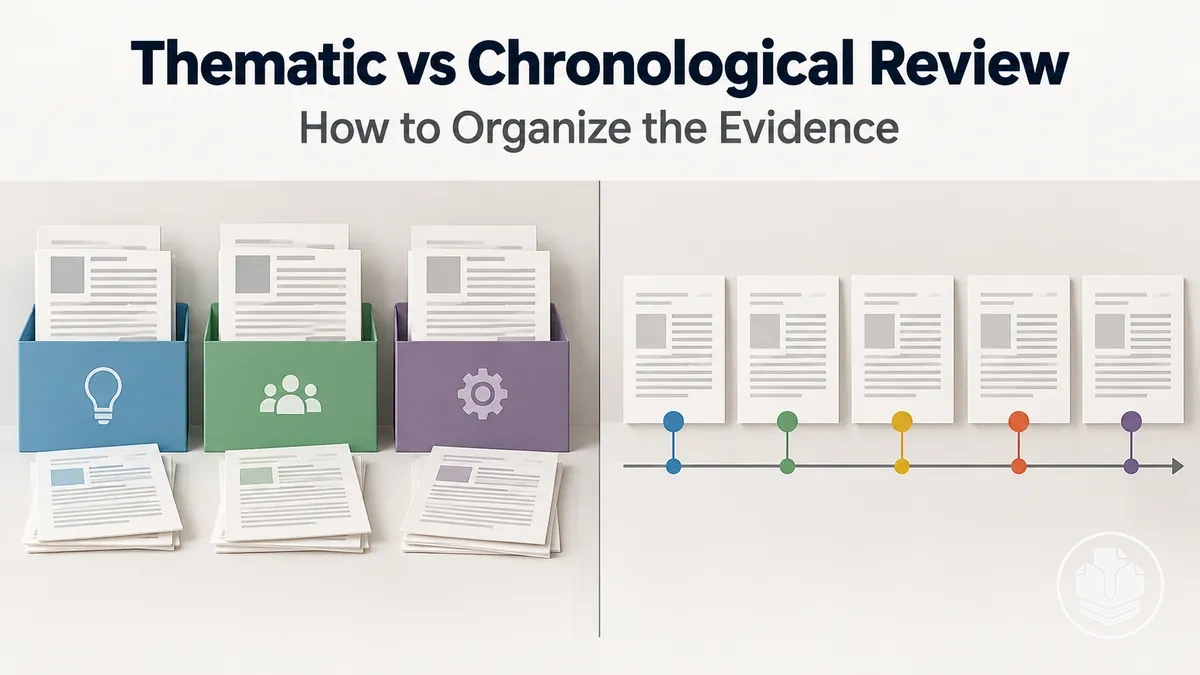
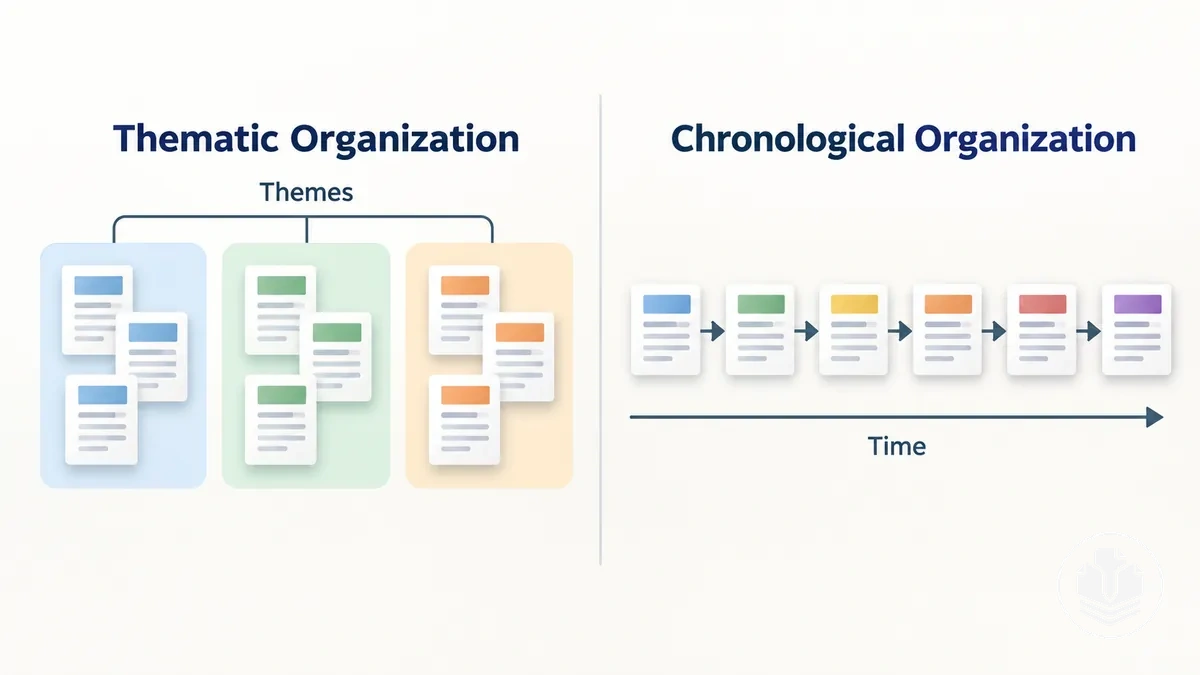
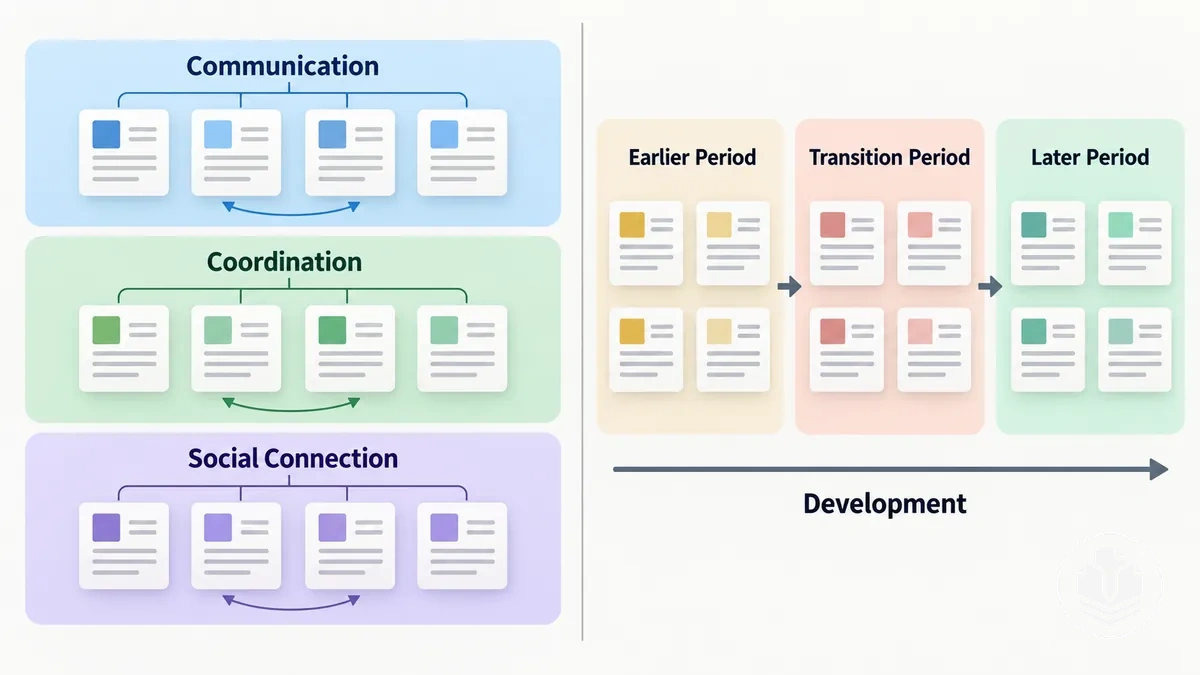
The image visualizes the same literature sources being reorganized into thematic clusters and a chronological sequence, making grouping versus sequencing visible without reproducing the table's attribute-by-attribute comparison.
The table compares the same dimensions for both structures—organizing principle, grouping unit, role of time, relationship made visible, and synthesis emphasis—so their organizational mechanics can be interpreted on a common basis.
Attribute
Thematic organization
Chronological organization
Organizing principle
Recurring themes, concepts, or issues
Time, sequence, or meaningful development
Grouping unit
Evidence relevant to the same theme or concept
Evidence associated with the same period or stage of development
Role of time
Secondary unless temporal change is relevant within a theme
Primary when sequence or development is analytically relevant
Relationship made visible
Cross-study relationships within a shared thematic category
Continuity, change, or development across the sequence
Synthesis emphasis
Connections, differences, and patterns across evidence grouped by theme
Connections, differences, and patterns interpreted through temporal development
Thematic Organization Groups Evidence by Recurring Themes
Thematic organization groups evidence in a literature review around recurring themes, concepts, issues, debates, variables, or other analytically meaningful categories.
Each theme acts as a grouping principle that brings together studies addressing a shared concept rather than treating publication order as the primary basis for organization.
A meaningful theme groups evidence because the shared concept is relevant to the review question, not simply because several sources can be placed under the same arbitrary label.
Within each theme, grouped studies can be compared or synthesized to make relationships in the evidence explicit.
Chronology can still appear within a theme when time or development provides useful local context, while the theme remains the primary organizing category.
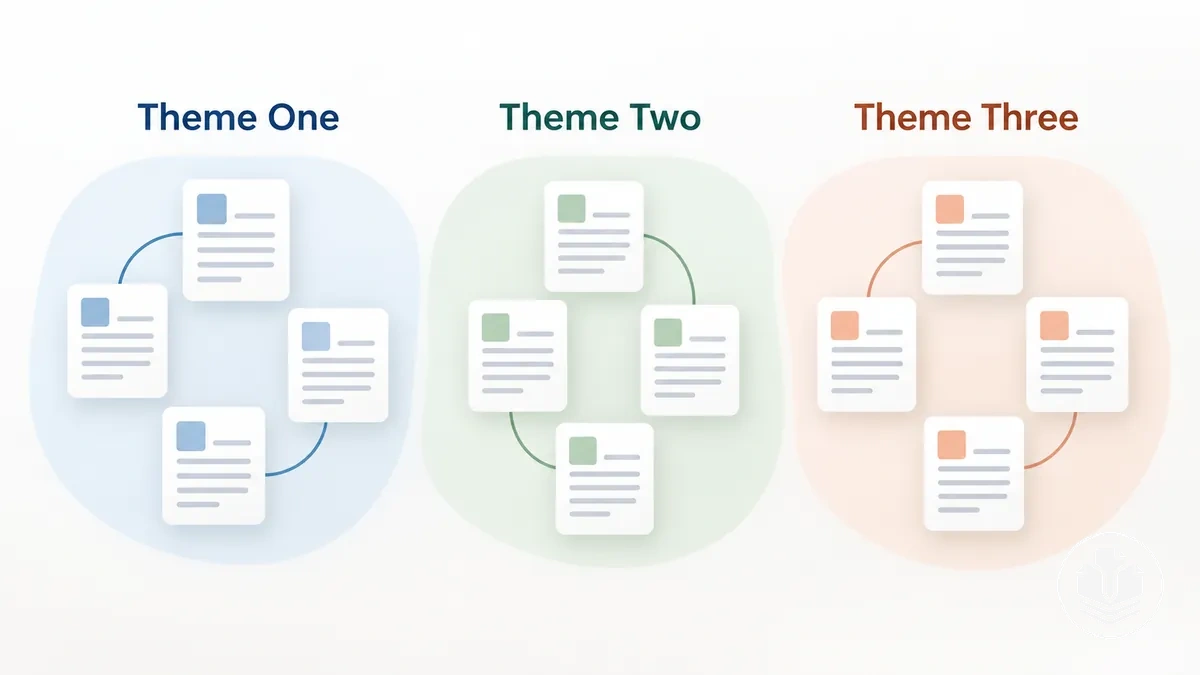
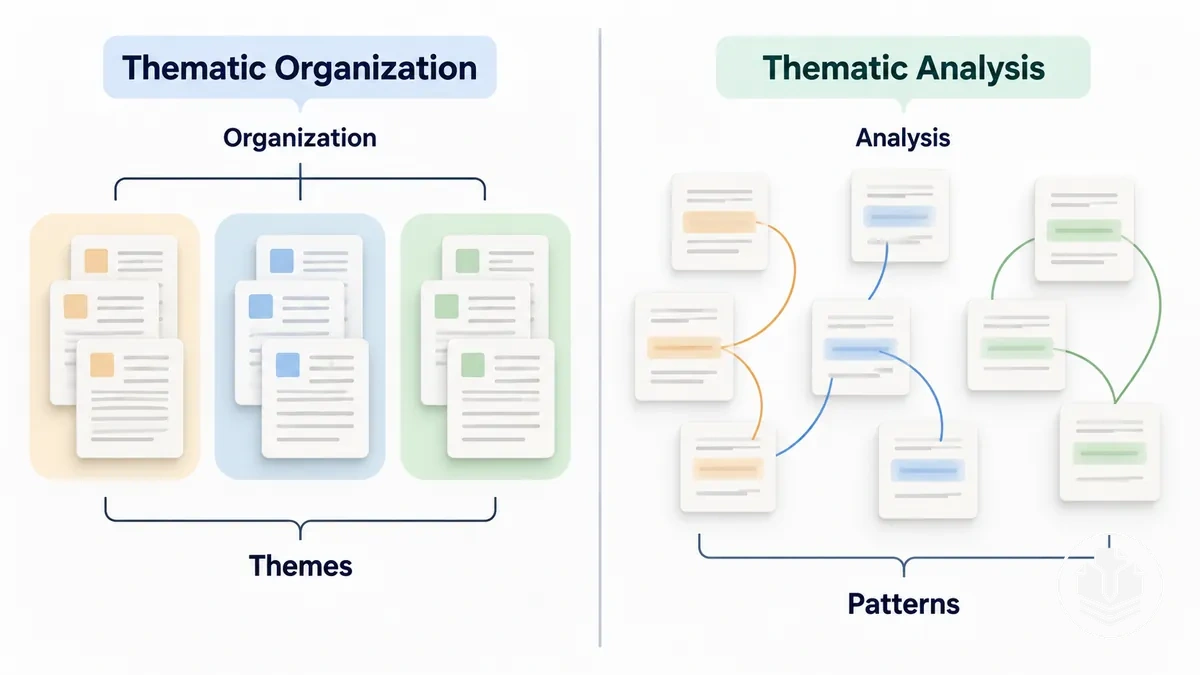
The image clarifies how recurring concepts group multiple sources as evidence within the thematic organization.
Chronological Organization Orders Evidence by Time and Development
Chronological organization arranges evidence in a literature review by time, using publication sequence, a historical period, a milestone, or a stage of development as the relevant temporal unit.
Evidence associated with each period or milestone is placed in sequence so the review can trace development or change when temporal progression matters to interpretation.
The sequence can therefore connect earlier and later evidence without implying that development is necessarily linear or that later work represents improvement.
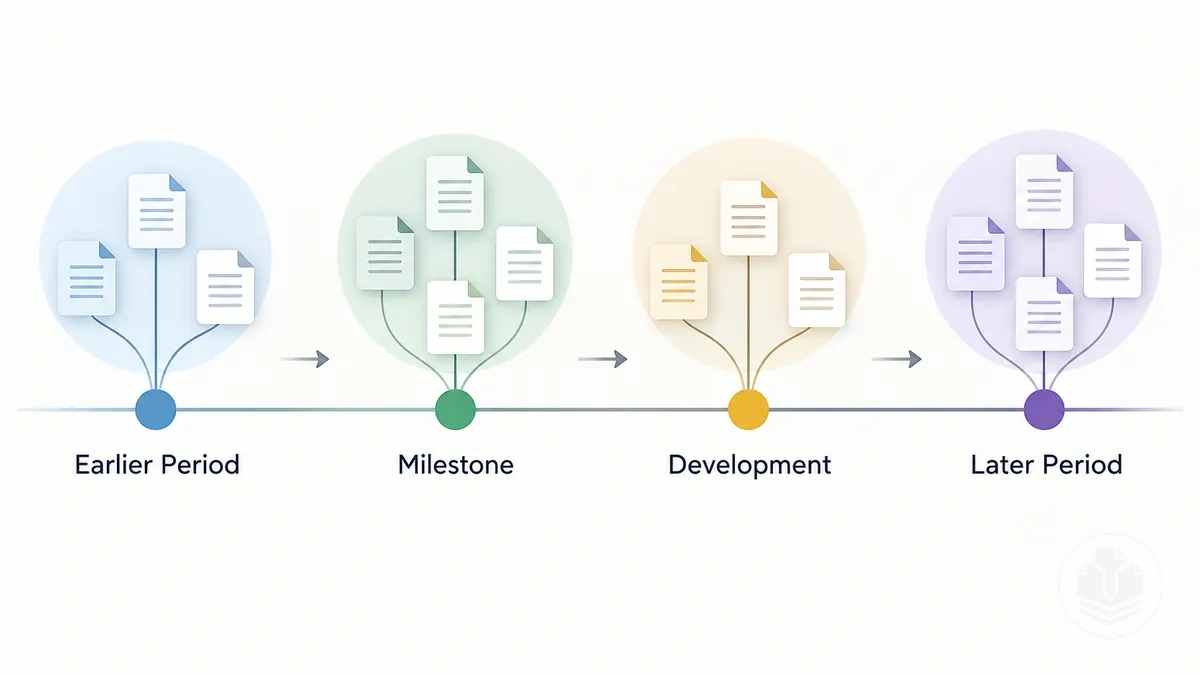
The image clarifies this temporal grouping by showing evidence associated with meaningful periods or developmental milestones rather than merely sorted by publication date.
Thematic Organization and Thematic Analysis Serve Different Functions
Key distinction: same adjective, different function
Thematic organization
Function
Organizes literature for presentation and synthesis.
Unit
Sources or evidence grouped under relevant themes.
What it establishes
How the literature review is structured; it does not, by itself, specify an analysis method.
Thematic analysis
Function
Identifies and interprets patterns in qualitative data or texts.
Unit
Qualitative material being analysed for recurring patterns.
What it establishes
An analytical method applied to qualitative material, not simply a way to arrange literature.
The image clarifies these similarly named but different functions by contrasting grouped literature evidence with qualitative material being examined for patterns.
A literature review can therefore use thematic organization without using thematic analysis: grouping sources under themes describes how the review presents and synthesizes evidence, while thematic analysis remains a method for analysing qualitative material.
Examples of Thematic and Chronological Organization
Consider a hypothetical literature review examining how remote work affects employee collaboration, using broadly the same illustrative evidence set in both versions.
The organizing principle changes while the review topic and evidence context remain broadly constant, so the example isolates the difference between thematic and chronological organization.
The image demonstrates the same evidence arranged under these two organizing principles.
Same topic, different organizing logic
Thematic version
Group the hypothetical remote-work evidence under themes such as communication practices, team coordination, and social connection. This foregrounds comparison among evidence addressing the same theme, regardless of its position in time.
Chronological version
Order the same evidence across meaningful periods or stages, such as an earlier period, transition period, and later period. This foregrounds development across the sequence rather than conceptual grouping.
Turning either structural illustration into connected prose is the separate task of learning to write synthesized paragraphs.
Criteria for Choosing Between Thematic and Chronological Organization
Choose between thematic and chronological organization according to what the review question, evidence pattern, and analytical purpose need to make visible, rather than treating organization as a stylistic preference.
Thematic organization is more suitable when interpretation depends primarily on recurring themes or cross-cutting relationships across the evidence.
Chronological organization is more suitable when historical development, milestones, or progression through time is central to interpretation.
When both patterns matter, suitability may support a combined structure rather than a strictly binary choice.
These criteria should be read as conditional signals rather than a scoring system: each criterion connects a feature of the review question or evidence to the organizing principle that makes that feature clearer.
Choosing that principle is distinct from the broader practical task of how to organize the sources collected for the literature review.
Review question: A question centered on concepts, issues, relationships, or recurring patterns favors thematic organization because grouping evidence by themes keeps those relationships visible. A question centered on change, development, or sequence through time favors chronological organization because temporal ordering supports that interpretation.
Pattern the review needs to foreground: When the analytical purpose is comparison across a recurring category, thematic organization supports grouped evidence and cross-cutting synthesis. When the purpose is to trace progression or shifts across periods, chronological organization makes that sequence more visible.
Strength of recurring themes: When meaningful themes recur across sources and connect evidence from different contexts or periods, thematic organization can make those relationships easier to interpret. When recurring themes are weak but temporal development provides a coherent relationship among the evidence, chronological organization can provide the clearer organizing principle.
Comparability of studies: When studies can be meaningfully compared around shared concepts, variables, debates, or issues, thematic organization supports comparison within those categories. When comparability changes substantially across periods because the relevant context or research focus develops over time, chronological organization can make those differences easier to interpret.
Importance of historical development: When time, milestones, or development materially affects how the evidence should be understood, chronological organization is more suitable because the sequence itself carries analytical meaning. When historical development is secondary to relationships that recur across time periods, thematic organization can keep those cross-cutting themes more prominent.
Mixed signals can justify a combined structure when both recurring themes and historical development are necessary to interpret the evidence in relation to the review question.
When Thematic Organization Fits the Review Question and Evidence
Thematic organization fits when recurring themes, concepts, or cross-cutting relationships matter more to the review question than temporal progression.
It is more suitable when the evidence needs to foreground relationships across studies around shared concepts, debates, mechanisms, populations, methods, or findings rather than make historical development the primary basis for interpretation.
The relevant condition is not simply that themes can be identified, but that thematic grouping makes an important evidence pattern clearer for the review question.
Different evidence conditions can therefore support thematic organization for different analytical purposes.
Recurring cross-cutting themes: When the same meaningful themes appear across evidence from different contexts or time periods, thematic organization can group that evidence around the shared relationship and support cross-study comparison.
Concept-driven review question: When the review question asks how a concept, mechanism, population, or issue is treated across the literature, thematic organization can foreground the relevant concept and support synthesis across evidence addressing it.
Competing debates or explanations: When evidence reflects distinct debates, explanations, or positions on a shared issue, thematic organization can group related evidence so points of agreement, contrast, and disagreement are easier to interpret.
Comparable findings or methods: When studies can be meaningfully related through comparable findings, methods, or recurring analytical categories, thematic organization can foreground those relationships instead of separating comparable evidence primarily by publication order.
Thematic organization is therefore more suitable when these cross-cutting relationships are important to interpretation; if temporal progression carries comparable analytical importance, the review question and evidence may support a mixed structure instead.
When Chronological Organization Fits the Review Question and Evidence
Chronological organization fits when development over time, historical phases, turning points, or changing theories or methods are themselves part of the review question's answer.
It is more suitable when the evidence contains a meaningful temporal progression that helps the review trace how an issue, body of knowledge, theory, or method changes across time periods.
Temporal sequence needs analytical significance rather than serving only as a way to sort citations by publication year.
The relevant situations are those in which periods, milestones, or shifts help explain the evidence pattern and its development.
Historical progression: When evidence reflects meaningful changes across time periods, chronological organization can trace that progression and foreground how the literature develops from one period to another.
Identifiable turning points: When a turning point changes the direction, emphasis, or context of the literature, chronological organization can position evidence around that shift and make the before-and-after relationship easier to interpret.
Meaningful milestones or phases: When the evidence can be associated with distinct milestones or historical phases that matter to the review question, chronological organization can show how those stages relate within the broader development.
Changing theories: When theories, explanations, or conceptual approaches shift over time, chronological organization can foreground the sequence of those changes without implying that later theories necessarily represent improvement.
Method development: When changes in methods are relevant to interpreting the evidence, chronological organization can trace when methodological shifts occur and how they relate to subsequent evidence.
Chronological organization is less useful when the evidence lacks meaningful temporal progression, because publication sequence alone does not provide explanatory value for the review question.
Trade-Offs of Thematic and Chronological Literature Review Structures
The trade-off between thematic organization and chronological organization depends on whether each structure's analytical emphasis matches the review question.
A feature that supports interpretation under one evidence pattern can become a limitation under another: thematic organization can foreground cross-study comparison while making change over time less visible, whereas chronological organization can foreground development while making cross-cutting relationships harder to sustain.
Neither consequence is inherently advantageous because its value depends on what relationships the review needs to make visible.
The comparison therefore concerns the conditions under which each structure supports or constrains interpretation, not which structure ranks higher.
Descriptive risk also remains possible with either structure when studies are listed within themes or sequences without meaningful relationships being established among the evidence.
Decision dimension
Thematic organization
Chronological organization
Practical implication
Analytical emphasis
Supports synthesis around shared themes when conceptual relationships carry the main analytical weight; it can obscure temporal development when those relationships are separated from meaningful changes across periods.
Foregrounds development and sequence when temporal relationships carry analytical weight; it can weaken attention to concepts that recur across different periods.
Use the emphasis that makes the relationships required by the review question most visible.
Visibility of change over time
Can make change over time less visible when evidence from different periods is grouped primarily around the same theme.
Makes change over time easier to trace when the evidence contains meaningful periods, shifts, or milestones; it adds less value when temporal differences have little explanatory significance.
Give temporal visibility greater weight when interpreting change across periods is part of the review's purpose.
Cross-study comparison
Supports cross-study comparison when evidence can be meaningfully related through recurring themes, concepts, debates, methods, or findings; fragmented thematic categories can weaken those relationships.
Can separate conceptually comparable studies when they fall in different time periods, although comparison remains possible when relationships are made explicit across the sequence.
Preserve conceptual comparability when relationships across studies matter more than their temporal position.
Risk of descriptive or fragmented treatment
Can become fragmented or descriptive when themes operate as separate containers and studies are listed without synthesis or relationships across the evidence.
Can become descriptive when studies are narrated in sequence without explaining why changes, continuities, or relationships across periods matter.
Organization alone does not remove descriptive risk; analytical relationships among studies must remain explicit.
Ease of tracing development
Can make development harder to trace when relevant stages or turning points are distributed across separate themes.
Can make development easier to trace when time periods, turning points, or milestones form a meaningful progression; it is less useful when the evidence does not support such progression.
Use chronological emphasis when tracing development contributes explanatory value rather than merely reproducing publication order.
Whichever structure is used, organization alone does not determine whether a literature review can synthesize studies; synthesis depends on establishing meaningful relationships among the evidence rather than merely listing studies within themes or time periods.
When a Combined Thematic-Chronological Structure Is Appropriate
A combined thematic-chronological structure is appropriate when one organizing principle remains primary and the secondary organizing principle adds necessary explanatory value.
Thematic organization can remain primary when themes carry the main analytical burden but development over time changes how one or more themes should be interpreted.
Chronological organization can remain primary when broad time periods structure the review but meaningful thematic comparisons are needed within those periods.
The combined structure should therefore remain nested rather than allowing theme and time to compete equally throughout the review.
Identify the primary organizing principle by asking which dimension most directly answers the review question and gives the evidence its main structure.
Use the secondary organizing principle only where it clarifies a local pattern that the primary structure would otherwise obscure; excessive switching between themes and time can weaken coherence by making the organizing logic difficult to follow.
The sequence below tests whether the combined structure adds explanatory value while keeping one dimension clearly dominant.
Identify the dominant analytical question: Determine whether the review question is mainly about relationships across themes or about development across time. That dominant analytical need establishes the basis for the combined structure.
Choose the primary organizing principle: Use thematic organization as the primary organizing principle when themes carry the main argument, or chronological organization when temporal progression carries the main argument. The primary principle should remain visible across the section or review so the reader can follow the structure consistently.
Test the secondary organizing principle locally: Add chronological organization within a theme only when time materially changes interpretation, or add thematic organization within a time period only when distinct thematic comparisons add necessary explanatory value. If the secondary dimension does not clarify an important evidence relationship, it does not need to be included.
Check coherence: Verify that the combined structure still has a clear hierarchy between the primary organizing principle and the secondary organizing principle. If both dimensions compete equally and the reader cannot tell whether themes or time controls the argument, the structure needs simplification or clearer nesting.
The coherence check is satisfied when the primary organizing principle remains easy to identify and the secondary principle appears only where it improves interpretation of the evidence.