
The Purpose of a Literature Review in Academic Research
A literature review synthesizes existing scholarship to establish what is known, ground the study’s theoretical and methodological choices, justify why further research is needed, and position the study’s intended contribution. Its value comes from relating evidence and identifying its boundaries, not from accumulating sources alone.
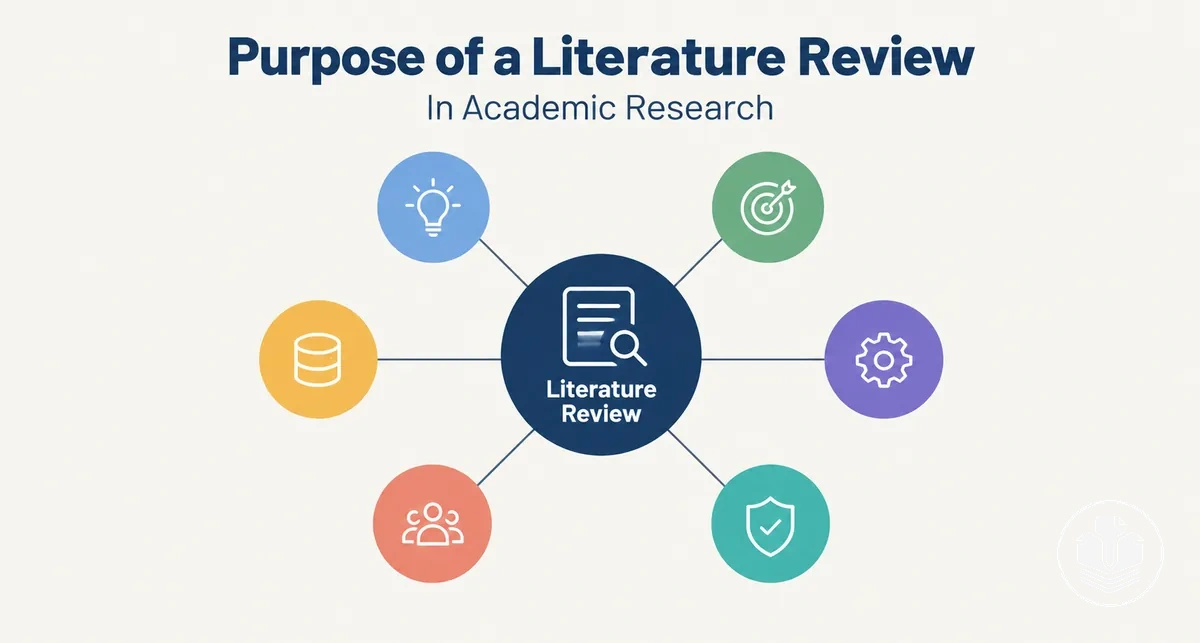
What a literature review does for a study
A literature review converts existing scholarship into four connected research functions. The emphasis can vary by discipline, review type, and research design, but the functions remain closely linked.
- Establish the knowledge stateIdentify supported findings, recurring themes, debates, boundaries, limitations, and uncertainty in the existing literature.
- Ground the studyConnect relevant concepts, theories, models, prior methods, measures, and analytical logic to the present research problem.
- Justify new researchShow the unresolved evidence need and explain why addressing it is relevant and potentially significant.
- Position the contributionLocate the proposed study relative to established knowledge and clarify whether it aims to confirm, extend, test, refine, or reframe prior understanding.
Existing scholarshipSynthesisResearch decisions and scholarly positioning
Synthesis gives the literature review greater value than simple source accumulation because it critically relates evidence across existing research.
The University of South Carolina Upstate identifies major purposes that include establishing a foundation of knowledge, relating prior works to one another, justifying further research, and positioning new research within existing literature.
The University of Illinois Springfield similarly explains that synthesizing relevant research creates a cohesive account of existing knowledge that can support an argument or original study.
In this way, the evidence base provides scholarly context and supports the justification and positioning of the proposed research.
The emphasis placed on these purposes can vary according to disciplinary conventions, review type, and research design.
However, a literature review derives its research value from what synthesis reveals about existing research and its relationship to the proposed study, rather than from source accumulation alone.
Table of Contents
What a Literature Review Establishes About Existing Research
A literature review establishes the state of knowledge by synthesizing what existing research shows, how findings relate, where interpretations differ, and which limitations constrain the evidence base.
These attributes provide scholarly context for judging what the existing literature can support and where its conclusions remain bounded.
Identifying prior studies shows that research exists, whereas synthesis interprets what the body of evidence collectively indicates.
This analytical function is central to the literature review definition: the review relates sources rather than treating them as an unconnected collection.
The illustration organizes the principal states a literature review can establish about existing research and their implications for a new study.

- Established knowledge: synthesis identifies findings supported within the reviewed evidence base, giving the new study a defined scholarly context.
- Patterns: recurring relationships or themes show how existing research is organized, helping the new study position its focus within prior scholarship.
- Agreement and disagreement: converging or conflicting interpretations indicate where conclusions are comparatively settled or contested within the reviewed literature.
- Limitations and boundaries: constraints in the available evidence define what current knowledge can reasonably support, strengthening the basis for a defensible research rationale.
These attributes matter because a new study inherits the conditions of the evidence base it builds upon.
Established knowledge provides context, disagreements qualify what can be claimed, and limitations define boundaries that should shape interpretation.
A literature review therefore creates a foundation for later research decisions by interpreting existing research rather than using publication count or source accumulation as a proxy for knowledge quality.
The Current State of Knowledge and Evidence
The state of knowledge is the overall condition of findings, agreement, consistency, evidence quality, and uncertainty within the literature.
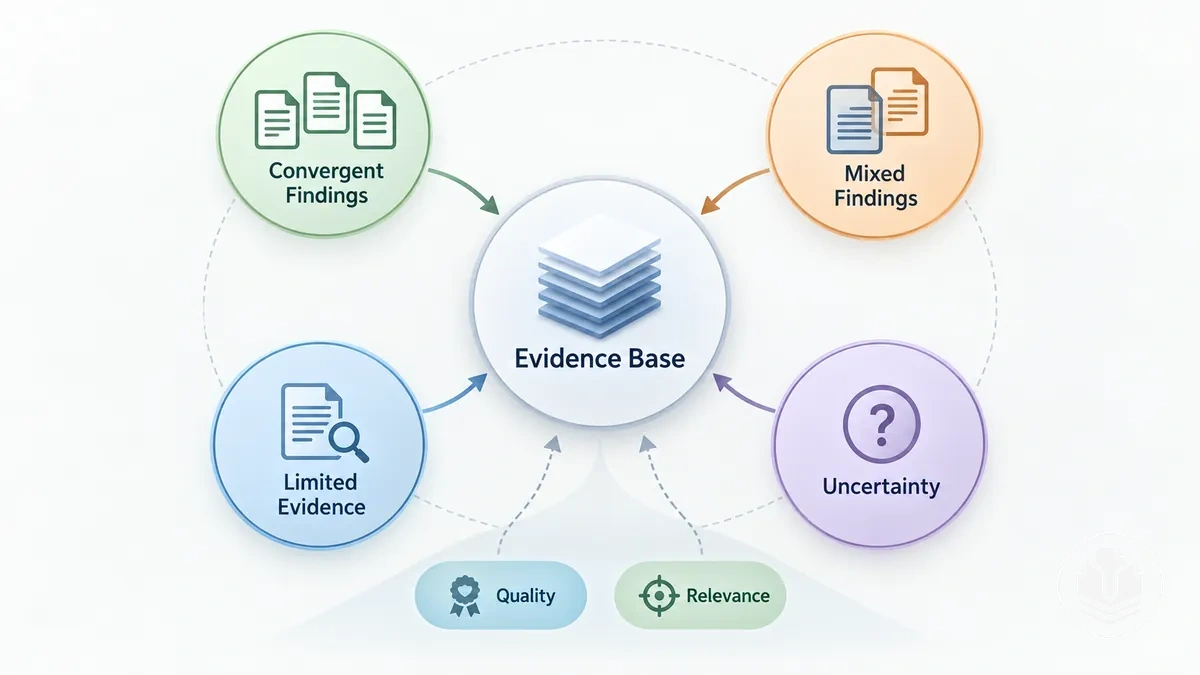
Synthesis shows whether current knowledge is supported by convergent findings, mixed results, limited evidence, or unresolved uncertainty.
These qualitative states affect how confidently a study can frame what is currently known.
Consistent and relevant evidence can support a more confident interpretation, while conflicting findings or important uncertainty require more qualified conclusions.
The diagram organizes these evidence states without ranking studies, because interpretation also depends on evidence quality and relevance.
For example, an academic review may find several studies addressing the same relationship yet reporting inconsistent findings across different contexts.
In that case, the synthesis supports the conclusion that research exists but that its combined evidence remains mixed rather than consistently supporting one interpretation.
More studies therefore do not necessarily mean stronger evidence when their quality, consistency, or relevance differs.
Major Themes, Debates, Boundaries, and Limitations in the Literature
Themes, debates, boundaries, and limitations are distinct attributes through which a literature review characterizes the existing literature and supports accurate interpretation.
Keeping them separate distinguishes recurring patterns from competing interpretations, conditions of applicability, and constraints within the evidence.
- Themes: recurring patterns or findings across the literature represent ideas or relationships that repeatedly emerge and shape interpretation of the research landscape.
- Debates: competing interpretations reflect substantive disagreement about how evidence should be understood, rather than every difference reported between studies.
- Boundaries: contextual or methodological conditions limit where findings may apply, constraining generalization beyond the circumstances represented in the literature.
- Limitations: weaknesses or constraints in the available evidence restrict what can be supported confidently without necessarily constituting research gaps.
These distinctions matter because similar observations can have different interpretive implications.
A boundary describes where applicability becomes constrained; defining the literature review scope is a separate procedural task.
The comparison graphic clarifies how the four categories relate to existing literature while keeping pattern, disagreement, applicability, and constraint conceptually distinct.

For example, a body of literature may show a dominant theme across the contexts studied while still having an unresolved limitation in the evidence available for other contexts.
The recurring theme can inform interpretation within the represented evidence, while the limitation may restrict broader generalization without automatically identifying a research gap.
How a Literature Review Grounds the Study's Theoretical and Methodological Framework
Prior scholarship grounds a study by providing the conceptual and methodological context against which its framework choices can be understood and defended.
A theoretical framework frames interpretation through relevant concepts, theories, constructs, or models, while a methodological framework connects the research problem with appropriate research design and analytical logic.
Conceptual grounding explains how prior scholarship shapes what the study examines and how its central relationships or assumptions are interpreted.
Theories can provide explanatory perspectives, concepts define relevant ideas, and constructs or models can organize relationships that the study investigates.
The diagram shows how this theoretical grounding and methodological grounding originate in prior scholarship while remaining distinct functions conditioned by fit with the research problem.
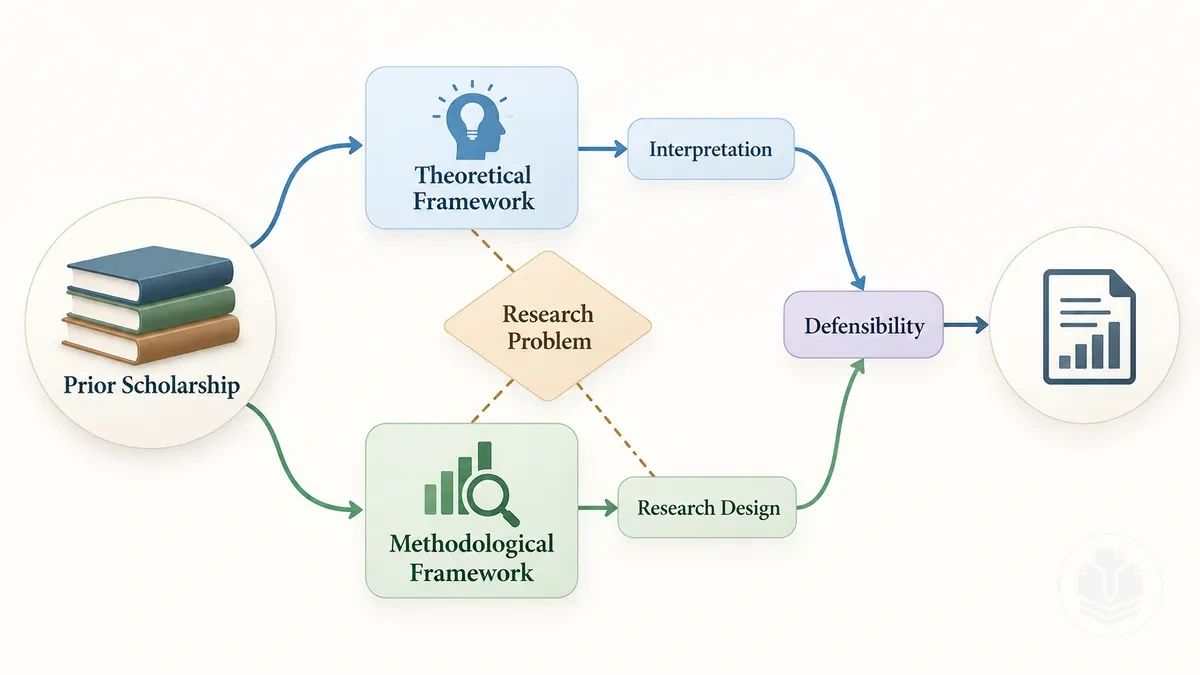
Methodological grounding connects prior research approaches with methodological choices such as research design, measures, and analytical logic.
Prior approaches can inform how a research problem has been investigated and provide a basis for explaining comparable design choices.
Their previous use supports defensibility only when the approach remains relevant to the present research problem, evidence, and design conditions.
Precedent alone does not establish that a theoretical framework or methodological framework is suitable for a new study.
Defensibility depends on fit with the research problem and evidential support for the concepts, assumptions, research design, and methodological choices being adopted.
Key Concepts, Theories, and Models That Frame the Study
Concepts, theories, and models provide the intellectual frame through which a research problem is defined, related to existing ideas, and interpreted.
Their precise meanings can vary by discipline, but each can shape the constructs, relationships, assumptions, and analytical perspective used within a study.
A concept names or defines an idea relevant to the research problem, while a theory can explain relationships and assumptions among concepts.
A model can represent or organize relationships, variables, or processes at a selected level of abstraction.
These framing elements can therefore make different relationships analytically prominent, and the illustration shows how each can influence interpretation of the same research problem.
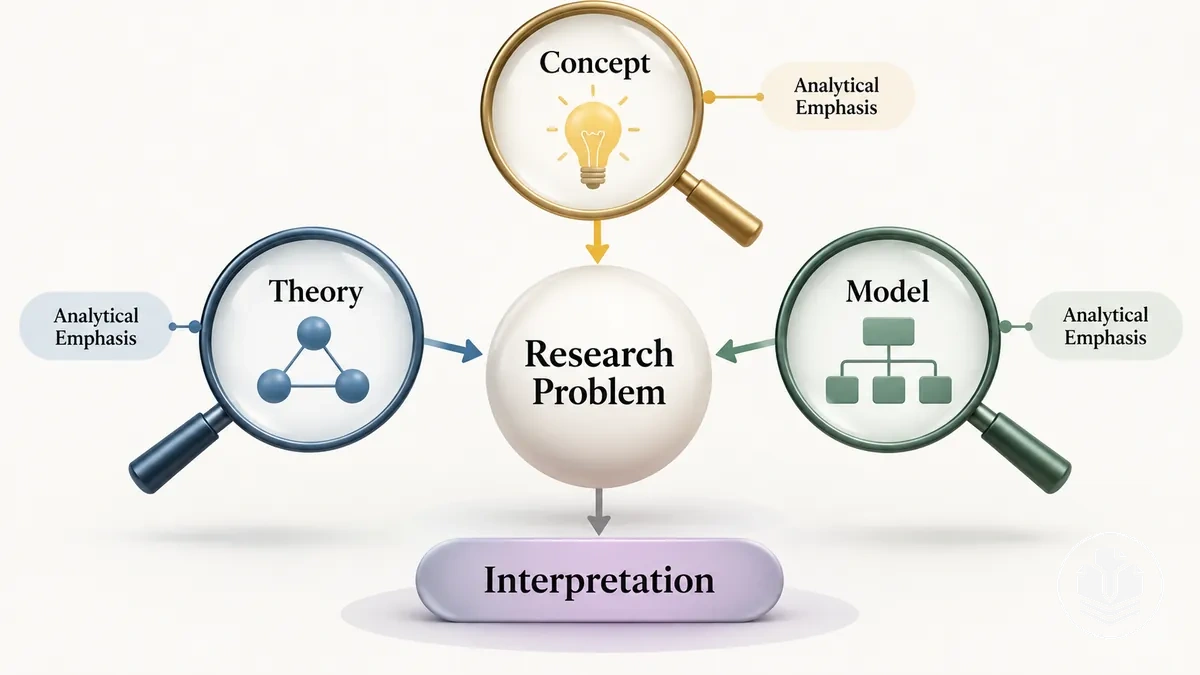
As an illustrative example, one theoretical lens may emphasize relationships between individual characteristics and an outcome, while another emphasizes contextual influences on that outcome.
The research problem remains the same, but the analytical emphasis and interpretation can change with the assumptions and relationships foregrounded by the lens.
Framing elements should therefore be chosen for relevance and evidential fit rather than name recognition or frequency of prior use.
How Prior Research Informs Research Questions and Methodological Choices
Prior research can inform both the focus of a research question and the defensibility of methodological choices.
Prior findings show what evidence already addresses the research problem, while unresolved patterns, context, measurement needs, and study design conditions help evaluate method fit.
- Inconsistent findings
- Question implication: narrow the research question toward the population, context, or relationship where uncertainty remains.
- Measurement limitation
- Method implication: evaluate an approach that better covers the construct or measurement need relevant to the research problem.
- Design differences
- Fit implication: examine the contextual conditions before adopting a similar research design or analytical approach.
For example, suppose earlier studies report inconsistent findings across two populations and use a measure that captures only part of the relevant construct.
The evidence could support a research question focused on the underexamined population while making measurement coverage a criterion for the study design.
Prior methods therefore provide evidence to evaluate against the research problem and method fit, rather than templates to copy.
How a Literature Review Justifies the Need for New Research
A literature review supports research justification when existing evidence reveals a meaningful unresolved need that warrants further investigation, rather than merely an unstudied topic.
The research rationale becomes defensible when the unresolved issue is relevant to the research problem and potentially significant for understanding it.
An important relationship may remain uncertain when comparable studies support different interpretations.
Conclusions may remain limited for a relevant population, condition, or context when the available evidence is too narrow or incomplete.
Further investigation may be warranted when meaningful changes make earlier findings less applicable to the present research problem.
New research may be justified when existing evidence does not adequately address the setting or population relevant to the proposed study.
A simple absence of publications establishes novelty, not necessarily a meaningful evidential need.
Justification requires showing why the unresolved issue matters within existing evidence, while the procedural task of identifying and defining a research gap remains separate.
Research Gaps as Evidence for Further Investigation
A research gap is an evidence limitation that leaves an important part of the research problem insufficiently resolved.
- Missing information
- A relevant relationship, population, condition, or context has not been adequately examined.
- Inadequate information
- Evidence exists, but its quality, scope, or coverage is insufficient for a confident conclusion.
- Inconsistent evidence
- Findings or interpretations conflict across relevant studies or conditions.
- Unresolved question
- Existing evidence does not yet support a sufficiently clear interpretation of an important issue.
Such a limitation may support further investigation when resolving it is relevant to the research problem and evidentially important.
This justificatory role is distinct from the procedural task used to identify research gaps.
For example, a recurring pattern of conflicting findings across comparable contexts can indicate a credible research gap because the existing evidence remains unresolved.
A research gap therefore reflects evidence adequacy and its resulting limitation, whereas a mere absence of a study does not establish sufficient justification by itself.
Establishing the Relevance and Significance of the Proposed Study
A documented limitation can establish relevance by connecting the proposed study to a specific unresolved issue, population, or context.
Significance is plausible when addressing the limitation could reduce consequential uncertainty or create scholarly value within the relevant context.
Boundary: relevance does not automatically establish significance, and a proposed contribution remains conditional until the study produces evidence that can be interpreted.
For example, an understudied topic has limited significance if the missing evidence has no clear consequence for the research problem.
By contrast, an unresolved issue that restricts interpretation in a relevant context can support both relevance and plausible significance before results are known.
How a Literature Review Positions the Study's Contribution
A literature review positions a study’s contribution by locating the proposed work relative to established findings, active debates, and unresolved limitations within existing scholarship.
This relationship gives the study a scholarly position by showing how its intended focus relates to prior knowledge.
The literature review positions what the study intends to contribute relative to existing scholarship. It may aim to confirm, extend, test, refine, or reframe prior knowledge, but this is not a guaranteed outcome.
The actual contribution depends on the evidence produced by the completed research and how that evidence changes, supports, qualifies, or reorganizes existing scholarship.
A literature review can support a defensible contribution claim in advance; demonstrated scholarly impact can only be assessed after results exist.
Relating the Study to Existing Scholarship
Scholarly positioning locates a study within existing scholarship by identifying the body of work, position, and evidence to which it responds.
This relationship establishes the study's starting point within the scholarly conversation without treating individual authors as the organizing structure.
A study may align with a position through agreement, extend a line of research, challenge an interpretation, or address unresolved tension.
Each relationship connects existing evidence to the study's scholarly position while leaving its eventual contribution dependent on completed research.
For example, a study may respond to a recurring scholarly position while examining whether its interpretation extends to a different context.
The study is positioned through relationships among ideas and evidence, not through the prestige of individual citations.
Extending, Testing, or Reframing Existing Knowledge
A proposed study can extend, test, or reframe existing knowledge, with each relation changing a different aspect of prior knowledge.
Extension broadens a boundary, testing examines a claim under defined conditions, while reframing changes the conceptual interpretation applied to the problem.
These distinctions clarify what must change relative to existing knowledge for each relationship to support a meaningful contribution.
- Extend: The proposed study extends existing knowledge when it broadens an established finding into a substantively different boundary or context. The contribution remains conditional on evidence showing that the broader application adds meaningful knowledge rather than minor contextual variation.
- Test: The proposed study tests an existing claim when it examines that claim under defined conditions using relevant evidence. The contribution can arise from clarifying whether the claim remains supported, requires qualification, or produces a different result under those conditions.
- Reframe: The proposed study reframes existing knowledge when it applies a different conceptual interpretation that changes how the research problem is understood. The contribution depends on whether that perspective yields a meaningful interpretive implication supported by the completed study.
Extending, testing, and reframing are therefore useful contribution relationships rather than an exhaustive taxonomy of how research can engage existing knowledge.
How the Purpose Applies Across Academic Research Contexts
The literature review purpose remains to connect a research project with existing scholarship, while its emphasis and evidential burden vary by academic context.
A thesis, research paper, or other project may therefore emphasize background, framework, justification, or contribution differently without changing that core purpose.
Several contextual conditions change how strongly a literature review must develop those functions and how deeply it must synthesize existing scholarship.
- Project scope: A broader or more complex project scope may require deeper synthesis to establish sufficient background and justify the study's boundaries.
- Disciplinary conventions: Different disciplinary conventions can change which forms of scholarly context, theoretical framing, or evidence receive greater emphasis.
- Research design: The research design can change the evidential burden for connecting prior scholarship with methodological choices, assumptions, and the research problem.
- Depth of synthesis: Expected depth of synthesis affects how extensively the review must relate findings, debates, limitations, and positions within existing scholarship.
These conditions explain why a thesis and a research paper can place different emphasis on the same literature review purpose.
The situations that follow illustrate contextual variation rather than prescribing a fixed length, universal structure, or identical expectation across academic settings.
Purpose in a Thesis or Dissertation
A thesis or dissertation literature review demonstrates field knowledge, synthesizes prior scholarship, establishes the study's framework, and supports research problem justification.
- Positioning
- Relate the extended research project to existing knowledge and unresolved scholarly issues.
- Depth
- Broader scope and originality expectations may require deeper synthesis and stronger justification.
- Boundaries
- Clarify which scholarship directly informs the research problem, framework, and proposed contribution.
- Variation
- Depth and emphasis depend on disciplinary conventions and institutional expectations rather than one universal structure.
Purpose in a Research Paper
A research paper literature review establishes relevant prior work, frames the research question or argument, and shows why the paper's analysis is needed.
- Context
- Connect selected scholarship directly to the problem, claim, or analytical focus addressed by the paper.
- Selection rule
- Prioritize evidence that directly contextualizes the research question or supports the argument within the defined scope.
- Scale
- A research paper typically addresses a narrower scholarly task, so its evidential burden is more focused than that of a thesis or dissertation.
- Variation
- Extent varies by discipline, assignment, journal, and research design; this changes scale and integration, not the standard of analysis.