
What Is a Literature Review?
A literature review is a structured examination of relevant existing scholarship within a defined focus. Rather than listing sources one by one, it analyses and evaluates individual contributions and synthesises relationships across sources to explain what the literature collectively suggests, where findings agree or differ, and what remains unresolved.
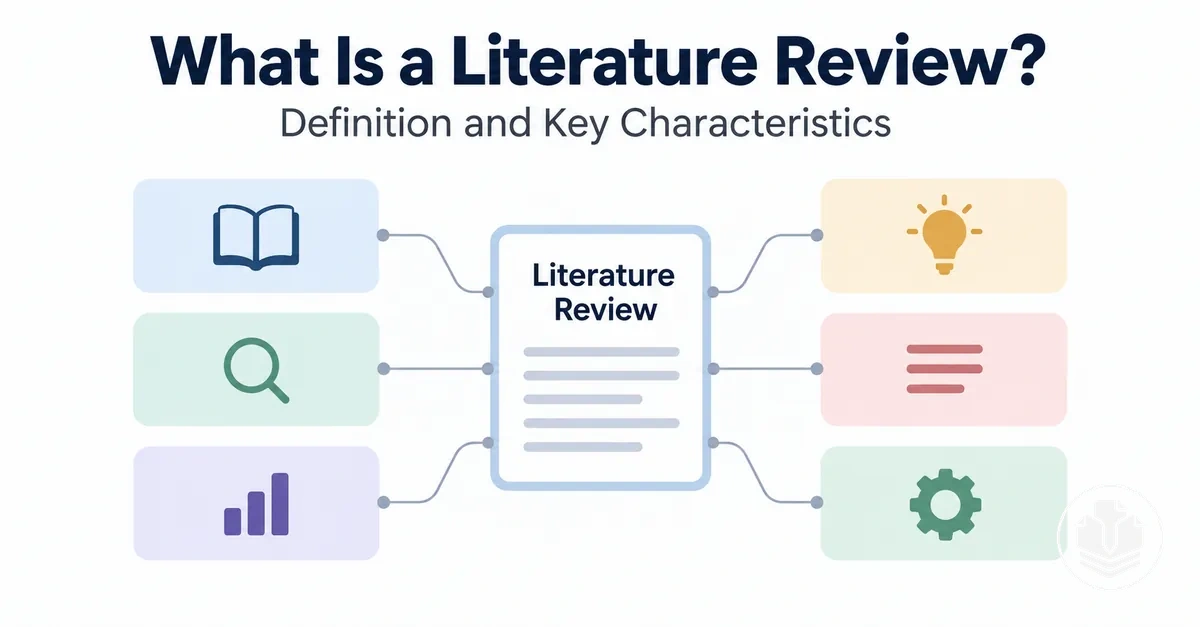
Literature review at a glance
A literature review is defined by how it selects, examines, and connects existing scholarship—not by one universal review method.
- Defined focus
- The review is bounded by a topic, research question, or other explicit scope.
- Relevant evidence base
- Sources belong because they contribute to that focus; merely mentioning the broader topic is not enough.
- Analysis and evaluation
- Claims, evidence, methods, strengths, limitations, and contributions are interpreted using criteria appropriate to the research context.
- Cross-source synthesis
- Evidence is organised around ideas and relationships to show patterns, agreement, disagreement, gaps, or unresolved uncertainty.
- Document role
- The review may be a standalone scholarly work or a section within a larger research paper, thesis, dissertation, or similar work.
Key boundary: source-by-source summary alone is not synthesis, and systematicity or methodological formality is not identical across every literature review.
The depth, comprehensiveness, and methodological formality of a literature review can vary by discipline and review type. What remains central is a coherent focus, a relevant evidence base, critical treatment of that evidence, and synthesis across sources.
Table of Contents
The Defining Characteristics of a Literature Review
A literature review is recognisable through a combination of defining characteristics rather than one isolated feature.
Together, these characteristics connect relevant research within a defined focus and make separate sources function as one coherent review.
The diagram organises the parallel characteristics that distinguish a literature review: a coherent focus for relevant research, analytical and evaluative treatment, and relationships developed through synthesis.

- Relevant research within a defined focus: the literature review draws on sources that contribute to its bounded topic or scope.
- Analysis and evaluation: the literature review analyses and evaluates evidence rather than relying only on description.
- Synthesis and coherent organisation: the literature review organises sources to reveal relationships, including shared ideas, differences, or patterns.
These attribute groups work together rather than operating as procedural steps.
Relevance establishes a coherent evidence base, analysis and evaluation support interpretation, and synthesis connects sources through meaningful relationships.
Their exact expression can differ by discipline or review type without reducing the literature review to a simple source list.
These defining features establish what qualifies the work as a literature review; why literature reviews are conducted is a separate question of purpose.
A recognisable literature review therefore combines relevant research within a defined focus with analysis, evaluation, synthesis, and coherent organisation.
Literature Reviews Draw on Relevant Research Within a Defined Focus
A literature review draws on research and scholarly sources that are relevant to its defined focus, such as a topic, research question, or bounded area of inquiry.
A source may mention the topic without being sufficiently relevant to the specific focus of the review.
The diagram illustrates this distinction by showing published sources in relation to a defined review boundary.

Relevant sources should fall within the review's scope and contribute meaningfully to its scholarly literature and evidence base.
Depending on the discipline and review type, scope may use topical, temporal, disciplinary, population, methodological, or publication-type boundaries. Eligible material can include peer-reviewed studies, scholarly books, conference papers, theses, and grey literature when the review's purpose and method make those sources appropriate.
Publication status by itself does not establish relevance, quality, or suitability; the source must fit the review's scope and contribute to the question being examined.
These boundaries keep the evidence base coherent enough to support meaningful comparison across the research.
A coherent evidence base brings together research that contributes to the same defined focus rather than material connected only by broad subject terminology.
This shared relevance provides the basis for comparing sources and, later, examining relationships through synthesis.
Literature Reviews Analyse and Evaluate Existing Research
A literature review does more than report what existing studies say; it uses analysis and evaluation to interpret what their evidence contributes.
This distinction separates description of a study from evidence-led assessment of its claims, methods, strengths, and limitations.
The image clarifies this relationship by separating what a study reports from how a literature review evaluates its contribution.

- Analysis
- Examines how a study's claim relates to its evidence and methods.
- Evaluation
- Assesses the significance, strengths, and limitations of that relationship using criteria appropriate to the study and its context, rather than personal opinion.
- Across studies
- Comparing these judgements can reveal consistency or disagreement and clarify how individual studies contribute to broader understanding of the field.
Literature Reviews Synthesise Sources Around Ideas and Relationships
Literature review synthesis integrates findings and ideas from multiple sources by showing relationships among them rather than summarising each source separately.
These relationships can reveal shared patterns, agreement, disagreement, tensions, or gaps across existing research.
The image organises these cross-source relationships as connections among findings rather than as a sequence of writing steps.

Synthesis relates evidence from multiple sources around shared or contrasting ideas, allowing individual findings to contribute to a cross-source interpretation.
Findings that support similar ideas may indicate a recurring pattern or agreement, while contrasting findings can expose disagreement or tension.
Connecting these relationships helps the literature review develop a broader interpretation of what existing research collectively suggests.
This integration distinguishes synthesis from source-by-source treatment without requiring separate findings to become one uniform answer.
Developing those relationships in practice belongs within the broader literature review process.
Where Literature Reviews Appear in Academic Research
In academic research, literature reviews commonly appear as either a standalone literature review or a literature review section within a larger research work.
A standalone review stands as an independent scholarly work, whereas an embedded review forms part of a research paper, thesis, dissertation, or similar document.
The graphic distinguishes these document contexts by placement and independence rather than by methodological review type.

Document context changes how independently the literature review functions and how it relates to the surrounding study.
As an independent work, the review develops its own synthesis and scholarly argument; as an embedded section, it supports the aims and context of the surrounding research.
Conventions for research papers, theses, and dissertations can vary, so this placement does not imply a universal section order.
This distinction provides broader context for literature review writing while keeping standalone and embedded placement conceptually separate.
Standalone Literature Reviews
- Document status
- A complete, independent work that examines and synthesises existing research.
- Primary scholarly task
- Analysis and synthesis of the research are the main task, so the review's synthesis and scholarly argument carry the principal analytical burden rather than serving as background for a separate empirical study.
- Methodological form
- The method can vary with purpose and academic context. Different types of literature reviews change how the review is conducted without changing its status as an independent work.
Literature Review Sections Within Larger Research Works
- Document status
- A component of a larger research paper, thesis, dissertation, or similar work rather than the complete document.
- Primary role
- Situates the larger study and its research question within relevant existing knowledge by connecting the study to its scholarly context.
- Scope and conventions
- Scope and emphasis are shaped by the surrounding study, while conventions can vary by discipline, institution, and study design; no universal placement or document structure follows from being an embedded review.
- Independence
- Its analytical role remains tied to the surrounding study rather than functioning as an independent review work.
How a Literature Review Differs from Related Academic Writing
A literature review may use many of the same sources as an annotated bibliography or research paper, but these forms differ in primary function and organisation.
Shared source use does not make these forms of academic writing interchangeable because each gives existing research a different scholarly role.
The comparison rests on four stable criteria: organizing unit, source treatment, relationship to original research, and synthesis burden.
The organizing unit distinguishes how material is arranged, while source treatment concerns whether evidence is described, analysed, or synthesised.
The relationship to original research considers whether existing scholarship is the central focus or supports a separate scholarly contribution, although research paper conventions vary.
These comparison criteria provide a consistent basis for distinguishing the literature review from each related academic form without ranking them.
Literature Review vs Annotated Bibliography
An annotated bibliography is organised source-by-source through individual annotations, whereas a literature review organises evidence across sources around ideas and relationships.
The comparison applies the same organizing criteria to clarify differences in analysis, synthesis, and narrative coherence.
| Criterion | Literature review | Annotated bibliography |
|---|---|---|
| Organizing unit | Ideas, themes, or relationships across sources | Individual sources presented through separate annotations |
| Treatment of sources | Summarises, analyses, evaluates, and connects evidence across sources | Summarises and may analyse or evaluate each source within its annotation |
| Cross-source synthesis | Synthesis connects findings or ideas from multiple sources | Cross-source synthesis is not the primary organizing function |
| Narrative structure | Develops narrative coherence around relationships in the literature | Maintains a source-centred sequence of annotated entries |
Both a literature review and an annotated bibliography may include summary, analysis, and evaluation, depending on the academic task.
Their principal difference is organisation: annotations remain centred on individual sources, while literature review synthesis connects evidence across sources.
This cross-source organisation supports narrative coherence around shared or contrasting ideas rather than separate source entries.
Literature Review vs Research Paper
A literature review primarily synthesises existing scholarship, while a research paper may use that scholarship to support a broader original argument, analysis, or empirical contribution.
The comparison therefore turns on each document's main research contribution and its use of existing evidence.
| Criterion | Literature review | Research paper |
|---|---|---|
| Primary contribution | Synthesis and interpretation of existing scholarship | May develop an original argument, analysis, or empirical research contribution |
| Role of existing research | Existing scholarship forms the principal evidence base for synthesis | Existing research may establish context, support analysis, and position the paper's contribution |
| Original argument or original research | Can develop original interpretation through relationships identified across existing research | May present an original argument, original analysis, empirical data, or another discipline-appropriate contribution |
| Relationship between the documents | Can function independently or as a literature review section within a larger paper | Can include a literature review as one component supporting the broader research work |
A literature review and a research paper can overlap without becoming interchangeable scholarly forms.
A literature review may provide a foundation for a research paper while retaining its distinct task of synthesis and interpretation.
Research papers do not universally require new empirical data; their contribution may instead take the form of original argument or analysis, depending on disciplinary conventions and the research question.